Christmas is the perfect time to teach your child a few Mandarin words, because the season is already full of things to name, count and say out loud. Whether your child wants to greet a Chinese-speaking classmate, surprise their lolo and lola, or simply learn something new over the holidays, it all starts with one greeting.
This guide shows how to say Merry Christmas in Chinese, how it is written in simplified and traditional characters, other greetings for the season, and 20 Christmas words your child can learn at home.
Merry Christmas in Chinese is 圣诞快乐 (shèng dàn kuài lè). In traditional characters, used in Taiwan and Hong Kong, it is written 聖誕快樂. It literally means “happy holy birth.”
How to Say Merry Christmas in Chinese
The Mandarin greeting has four characters, and each one has its own meaning.
| Character | Pinyin | Meaning |
|---|---|---|
| 圣 | shèng | holy |
| 诞 | dàn | birth |
| 快 | kuài | happy, quick |
| 乐 | lè | joy, happy |
圣诞 (shèng dàn) is the word for Christmas, and 快乐 (kuài lè) means happy. All four syllables use the falling fourth tone, so it helps to say each one firmly, like a short and cheerful command. If your child is still getting used to tones, our guide to pinyin for kids explains how they work.
Merry Christmas in Traditional Chinese Characters
Mainland China uses simplified characters, so the greeting is written 圣诞快乐. In Taiwan and Hong Kong, and in some Filipino-Chinese schools, you will see the traditional version, 聖誕快樂. Both are pronounced the same way in Mandarin. If your child’s school uses one or the other, our guide to simplified and traditional characters explains the difference.
Other Christmas Greetings in Mandarin
| Mandarin | Pinyin | Meaning |
|---|---|---|
| 祝你圣诞快乐 | zhù nǐ shèng dàn kuài lè | Wishing you a Merry Christmas |
| 圣诞快乐,新年快乐 | shèng dàn kuài lè, xīn nián kuài lè | Merry Christmas and Happy New Year |
| 平安夜快乐 | píng ān yè kuài lè | Happy Christmas Eve |
| 谢谢你的礼物 | xiè xie nǐ de lǐ wù | Thank you for the gift |
祝你 (zhù nǐ) means “I wish you,” so adding it to the front makes any greeting sound warmer. It is a nice one to write inside a Christmas card.
20 Christmas Words in Chinese for Kids
These are the words children use most during the season. Pick five to start with and add a few more each day.
| Mandarin | Pinyin | Meaning |
|---|---|---|
| 圣诞节 | shèng dàn jié | Christmas |
| 平安夜 | píng ān yè | Christmas Eve |
| 圣诞老人 | shèng dàn lǎo rén | Santa Claus |
| 圣诞树 | shèng dàn shù | Christmas tree |
| 礼物 | lǐ wù | gift |
| 星星 | xīng xing | star |
| 铃铛 | líng dang | bell |
| 雪 | xuě | snow |
| 雪人 | xuě rén | snowman |
| 驯鹿 | xùn lù | reindeer |
| 圣诞袜 | shèng dàn wà | Christmas stocking |
| 蜡烛 | là zhú | candle |
| 天使 | tiān shǐ | angel |
| 彩灯 | cǎi dēng | Christmas lights |
| 姜饼人 | jiāng bǐng rén | gingerbread man |
| 苹果 | píng guǒ | apple |
| 蛋糕 | dàn gāo | cake |
| 家人 | jiā rén | family |
| 唱歌 | chàng gē | to sing |
| 新年快乐 | xīn nián kuài lè | Happy New Year |
Santa Claus is a fun one to explain. 圣诞老人 (shèng dàn lǎo rén) means “the old man of Christmas,” which children usually find very funny.
Christmas Songs in Chinese for Kids
Songs are one of the easiest ways for children to pick up new words, because the melody does most of the remembering for them. These four classics are sung in Mandarin by Little Fox Chinese, a children’s channel made for young learners, and most kids already know the tunes in English.
Jingle Bells (铃儿响叮当)
The Mandarin title means “the bells ring ding-ding-dong.” Listen for 叮叮当 (dīng dīng dāng), the sound of the bells, and let your child ring along.
We Wish You a Merry Christmas (我们祝你圣诞快乐)
This one repeats 圣诞快乐 again and again, so it is a perfect way to practice the greeting from the top of this guide.
O Christmas Tree (噢,圣诞树)
A slow, gentle song that helps younger children hear 圣诞树 (shèng dàn shù), Christmas tree, clearly. Try pointing to your own tree each time you hear it.
Deck the Halls (迎圣诞)
The Mandarin title means “welcome Christmas.” It is lively and fun for dancing while you put up the decorations.
Why Families in China Give Apples on Christmas Eve
Here is a fun fact your child can share at school. In Mandarin, Christmas Eve is called 平安夜 (píng ān yè), which means “peaceful night.” The word for apple, 苹果 (píng guǒ), starts with a similar sound to 平安 (píng ān), which means peace and safety.
Because of that wordplay, many families and friends in China give each other apples on Christmas Eve, often wrapped in colorful boxes or paper. These are called 平安果 (píng ān guǒ), or “peace apples,” and giving one is a way of wishing someone a safe and peaceful year.
Easy Ways to Practice at Home This Christmas
- Sing along. Play one of the songs above while you decorate, and sing the chorus together.
- Greet the family. Have your child say 圣诞快乐 to everyone at Noche Buena. Lolo and lola will love it.
- Count the gifts. Count presents under the tree in Mandarin. Our guide to Chinese numbers 1 to 10 makes it easy.
- Label the decorations. Put sticky notes with 星星, 礼物 and 圣诞树 on the star, gifts and tree.
- Write a card. Help your child copy 圣诞快乐 into a Christmas card for a classmate or teacher.
- Give a peace apple. On Christmas Eve, wrap an apple and give it to someone while saying 平安夜快乐.
Give Your Child a Mandarin Head Start This Christmas
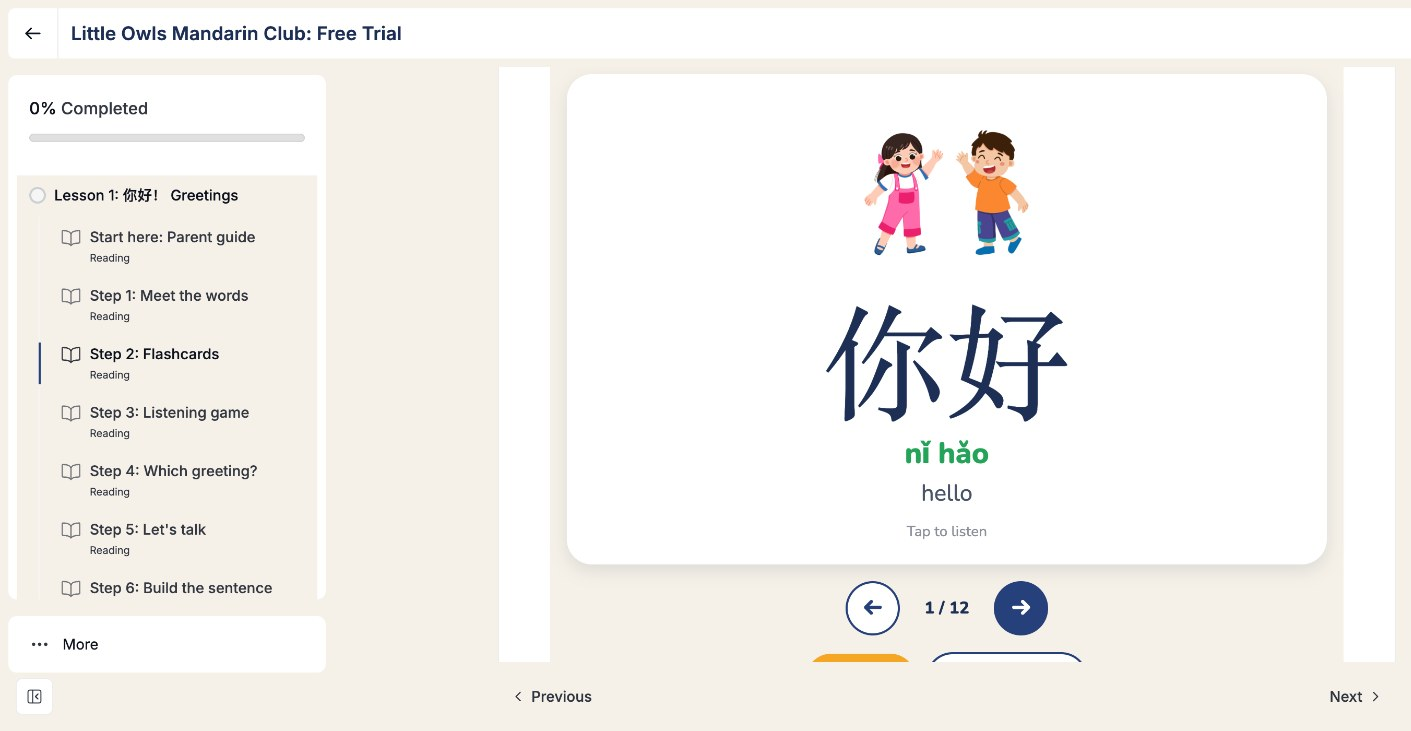
Lesson 1 of the Little Owls Mandarin Club, our online self-study course for kids, starts with greetings using picture flashcards, speaking practice with Lili, games and a short quiz. A lesson takes 15 to 20 minutes, and your child can try the first one free.
Try Lesson 1 FreePrefer a live teacher? Book a trial classFrequently Asked Questions
How do you say Merry Christmas in Chinese?
Merry Christmas in Mandarin Chinese is 圣诞快乐, pronounced shèng dàn kuài lè. In traditional characters it is written 聖誕快樂.
What is Santa Claus in Chinese?
Santa Claus is 圣诞老人 (shèng dàn lǎo rén), which means “the old man of Christmas.”
Is Christmas celebrated in China?
Christmas is not a public holiday in mainland China, but it is popular in cities, especially with young people. Shopping malls put up Christmas trees and lights, and friends give each other apples on Christmas Eve.
What does 圣诞 mean?
圣 (shèng) means holy and 诞 (dàn) means birth, so 圣诞 refers to the birth of Jesus. Together with 节 (jié), meaning festival, it forms 圣诞节, the word for Christmas.
For more everyday words, see our lists of basic Chinese words for beginners and common Chinese phrases.
Sources: That’s Magazine, “Why China celebrates Christmas with apples.”