“My daughter’s teacher keeps talking about pinyin. Is that the Chinese alphabet?” It’s a question we hear often from Filipino parents, especially when their child brings home a worksheet full of letters with little marks over them.
The short answer is that Chinese has no alphabet. It is written in characters, and each one stands for a whole syllable and a meaning. Pinyin is the system that spells those characters with the same Latin letters your child already knows, so learners can see how each word should sound. In this guide, you’ll learn how pinyin works, hear the four tones for yourself, and try a short game that helps your child tell them apart.
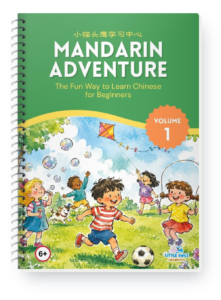
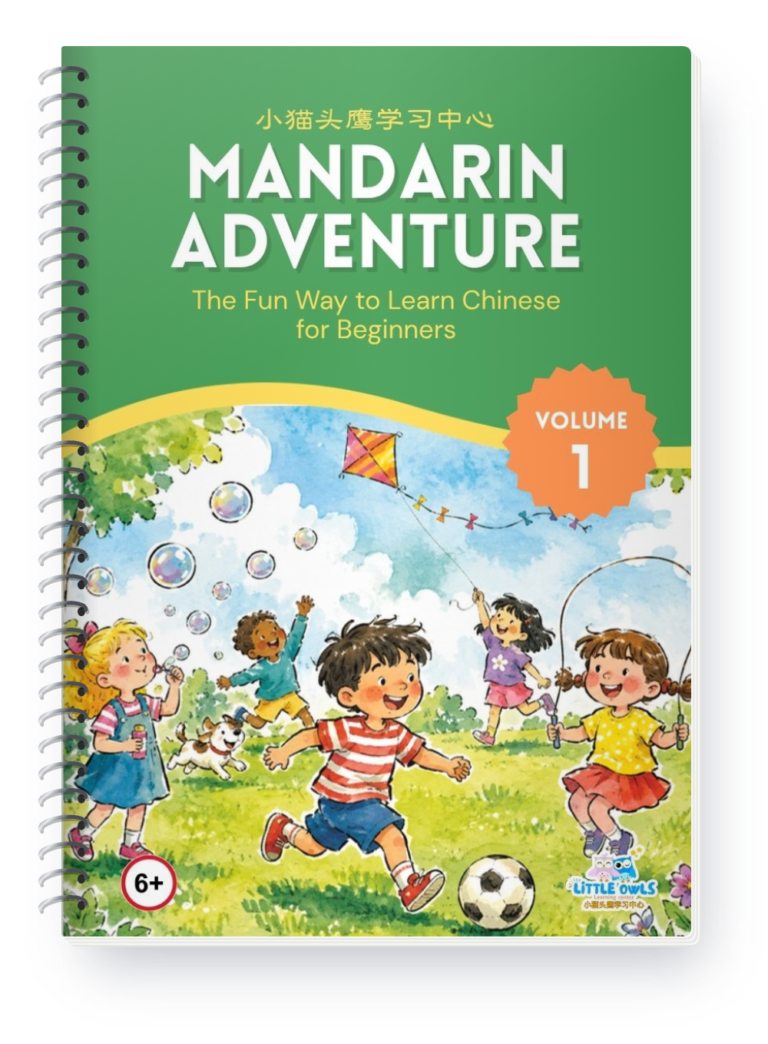
See pinyin in action with a real lesson. Lesson 1 of our Mandarin Adventure workbook is free, with pinyin and English under every Chinese word so you can read along with your child. Get the free lesson ↓
Want a teacher to guide your child? Book a ₱599 trial class
Chinese Uses Characters, Not an Alphabet
Each Chinese character is a single syllable with its own meaning. In English or Filipino, letters stand for sounds, and you combine them to spell any word. Chinese works differently, because a character like 妈 (mā, mom) tells you the meaning, but nothing in its shape spells out exactly how to say it.
That is why children learn characters gradually, a few at a time. A young learner does not need to know thousands of characters to start speaking. Our Level 1 students begin with everyday words like numbers, names and family members, and they build up from there with plenty of review.
What Pinyin Is and Why Your Child Learns It First
Pinyin is the official way to write Mandarin sounds using Latin letters. It was adopted by the Chinese government in 1958 and by the International Organization for Standardization in 1982, and it is now the standard system used to teach Mandarin in mainland China and around the world. Britannica describes it as a romanization based on the pronunciation of Mandarin as spoken in Beijing.
Every pinyin syllable has up to three parts. There is a starting sound called an initial, an ending sound called a final, and a tone mark that tells you how your voice should move. In mā, for example, “m” is the initial, “a” is the final, and the flat line above the “a” is the first tone.
Pinyin is a support, and children gradually rely on it less. It helps beginners read new words out loud, it appears under every Chinese word in our Mandarin Adventure lessons, and it is also how most people type Chinese on a phone. As children recognize more characters, they look at the pinyin less and less.
The Four Tones and a Game to Practice Them
Tones are the part of pinyin that surprises Filipino kids the most. In Filipino and English, your voice rises and falls to show feeling, but the word stays the same. In Mandarin, the pitch is part of the word itself, so the same syllable said with a different tone can mean something completely different.
The classic example is “ma.” Said with a flat, high voice, mā means mom. With a rising voice, má means hemp. With a low dip, mǎ means horse, and with a sharp fall, mà means to scold. Kids often remember the set as a tiny story: mom scolds the horse. Tap each syllable below to hear the difference, then try the tone detective game.
The Four Tones
The line above the vowel shows how your voice moves. Tap any syllable below to hear it.
Tone Detective
Press play, listen closely, then tap the tone you heard.
There is also a neutral tone with no mark at all. It is short and light, and you will hear it at the end of words like 妈妈 (māma, mom) or in little words like 吗 (ma), which turns a sentence into a question. You do not need to drill it separately, because children pick it up naturally from listening.
Pinyin Sounds That Trip Up Filipino Kids
Filipino children read pinyin the way they read Filipino, and that causes a few predictable mistakes. Filipino spelling is very close to how words sound, so kids naturally say each letter the Filipino way. A handful of pinyin letters sound quite different from what they expect. Tap each card to hear the real sound.
The “q” and “x” sounds cause the most confusion. Children often read 七 (qī, seven) as “kee” and 西 (xī, west) as “zee.” Practicing those two side by side with the recordings fixes the habit quickly. Our guide to Chinese numbers 1 to 10 is a good place to keep practicing, because the numbers include several of these sounds.
Pinyin vs. Zhuyin: What Chinese Schools Use
Some Filipino-Chinese schools teach zhuyin instead of pinyin. Zhuyin, sometimes called bopomofo, uses its own set of symbols to show pronunciation and is common in Taiwan. If your child’s school uses it, the tones and sounds are the same, and only the way they are written changes. Our guide to simplified vs. traditional characters and pinyin vs. zhuyin explains which system each type of school tends to use and how tutoring can match it.
How to Practice Pinyin at Home
A few minutes of listening every day matters more than memorizing rules. These simple habits work well, even if you do not speak Mandarin yourself:
- Listen before reading. Play a word first, then show your child the pinyin, so the sound comes before the spelling.
- Trace the tone with a finger. Have your child draw the tone line in the air as they say a word. It turns an abstract idea into a movement they can feel.
- Exaggerate at first. Big, dramatic tones are fine for beginners. They naturally get smoother with practice.
- Play tone detective together. Take turns with the game above and see who gets the higher score.
- Use material with pinyin and English. It lets you follow along and correct gently, even as a beginner yourself.
If you want more structure, start with real lessons. Our guides to common Chinese phrases and helping with Mandarin homework when you don’t speak Chinese have more ideas, and Lesson 1 of our workbook is free below.
Get Lesson 1 free, and we’ll email it to you right away.
Get Lesson 1 Free
Try the first lesson with your child at home. We’ll email you the PDF right away.
Try a Live Class with a Teacher
The fastest way to get tones right is practicing with a teacher who can hear your child and correct them on the spot. Book a trial class and a teacher will meet your child online: 45 to 60 minutes in a small group of up to four children, for ₱599, with no obligation to enroll. Prefer to practice at home first? Mandarin Adventure at Home pairs our workbook with videos, flashcards and listening games. Have a question about where your child should start? Message us on WhatsApp or Messenger, or email info@littleowlsph.com. We reply Tuesday to Saturday, 10am to 6pm.