Mandarin Chinese is one of the most widely spoken languages in the world, and for many parents, it’s a skill they want their children to master for the future. But the truth is you don’t need to be fluent in Chinese yourself to help your child get started.
Like every language, the journey begins with basic Chinese words such as greetings, pronouns, numbers, and simple questions. These aren’t just vocabulary items though but more of stepping stones to building confidence and forming real sentences.
In this guide, we’ll go beyond just listing words. We’ll show how they’re used in context, share cultural notes that make them memorable, and provide parent-friendly tips so you can practice with your child at home.
1. Greetings and Everyday Phrases
Greetings are usually the first words anyone learns in a new language. They set the tone for communication and are easy to practice daily. You can use them with your child at home, during playtime, or even as part of their school routine.
- 你好 (Nǐ hǎo) – Hello
- Example: 你好,老师!(Nǐ hǎo, lǎoshī!) – Hello, teacher!
- Parent Tip: Use 你好 each morning instead of “Good morning.” It becomes part of your child’s routine.
- Example: 你好,老师!(Nǐ hǎo, lǎoshī!) – Hello, teacher!
- 谢谢 (Xièxiè) – Thank you
- Example: 谢谢你!(Xièxiè nǐ!) – Thank you!
- Cultural Note: Saying 谢谢 isn’t just politeness, it reflects the value of 礼貌 (lǐmào), or respect and courtesy, which is highly important in Chinese culture.
- Example: 谢谢你!(Xièxiè nǐ!) – Thank you!
- 再见 (Zàijiàn) – Goodbye
- Example: 再见,朋友!(Zàijiàn, péngyǒu!) – Goodbye, friend!
- Parent Tip: Encourage kids to say 再见 when leaving the house or ending an online class.
- Example: 再见,朋友!(Zàijiàn, péngyǒu!) – Goodbye, friend!
- 请 (Qǐng) – Please
- Example: 请坐 (Qǐng zuò) – Please sit.
- This reinforces politeness in everyday interaction.
- Example: 请坐 (Qǐng zuò) – Please sit.

2. Basic Pronouns
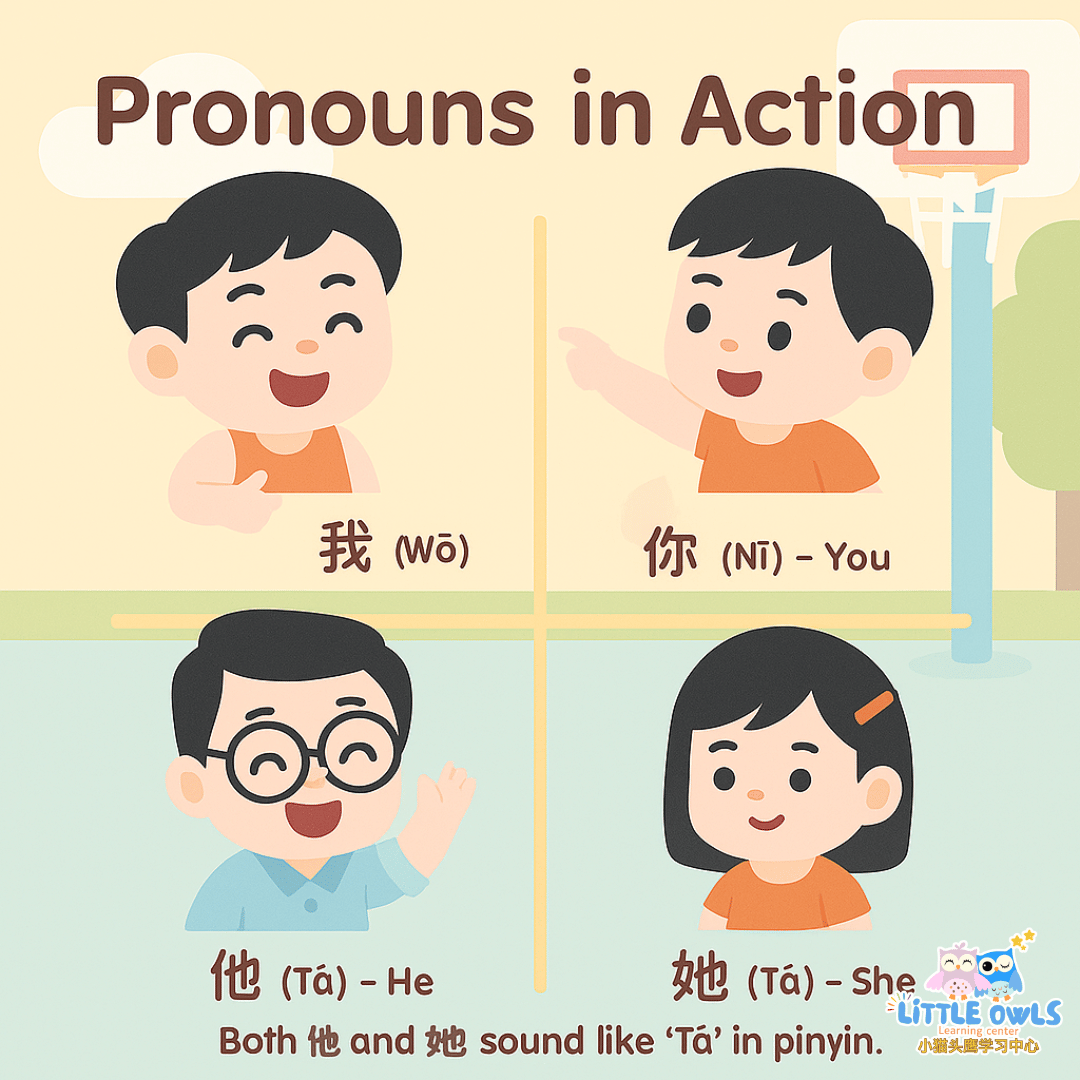
Pronouns are some of the most powerful tools your child can learn because they open the door to making sentences about themselves and others. Instead of only naming objects, your child can now say who is doing the action, which makes their Mandarin feel instantly more alive.
In Mandarin, pronouns are straightforward. Unlike English, they don’t change based on tense, and they’re very consistent to use. That makes them especially beginner-friendly and a great stepping stone toward full sentences.
- 我 (Wǒ) – I / Me
- 你 (Nǐ) – You
- 他 (Tā) – He
- 她 (Tā) – She
Examples:
- 我是学生 (Wǒ shì xuéshēng) – I am a student.
- 我喜欢书 (Wǒ xǐhuān shū) – I like books.
Parent Tip: Try simple role-play. Point to yourself and say “Wǒ,” then point to your child and say “Nǐ.” It’s fun, interactive, and kids love it when words connect to people they already know.
3. Numbers 1–10
Counting is both practical and fun, which makes numbers one of the easiest places to start. Your child can use them immediately in daily life, counting toys, steps, or even snacks.
Mandarin numbers are also logical. Once your child learns 1–10, it’s easy to build bigger numbers by following patterns. That sense of progress builds confidence fast.
- 一 (Yī) – One
- 二 (Èr) – Two
- 三 (Sān) – Three
- 四 (Sì) – Four
- 五 (Wǔ) – Five
- 六 (Liù) – Six
- 七 (Qī) – Seven
- 八 (Bā) – Eight
- 九 (Jiǔ) – Nine
- 十 (Shí) – Ten
Example: 我有三本书 (Wǒ yǒu sān běn shū) – I have three books.
Practice Idea: Count toys in Mandarin: “Yī, èr, sān” as you stack blocks.
Cultural Note: In Chinese culture, numbers carry meaning. 8 (八 bā) is lucky because it sounds like “wealth,” while 4 (四 sì) is unlucky because it sounds like “death.”
4. Simple Question Words
Once your child knows greetings and numbers, the next step is asking questions. This is where language becomes interactive instead of just memorized.
Mandarin keeps it simple: the word order stays the same, and you just drop in the question word where it belongs. That means kids can experiment with questions right away.
- 什么 (Shénme) – What
- 谁 (Shéi) – Who
- 哪里 (Nǎlǐ) – Where
- 什么时候 (Shénme shíhòu) – When
- 为什么 (Wèishénme) – Why
- 怎么 (Zěnme) – How

Example: 这是什么?(Zhè shì shénme?) – What is this?
Parent Tip: During playtime, hold up a toy and ask “Zhè shì shénme?” Encourage your child to answer in Mandarin.
Cultural Note: In many Chinese classrooms, kids are encouraged to ask “为什么 (wèishénme) – why?” This reflects the cultural value placed on curiosity and critical thinking.
5. Everyday Nouns and Adjectives
At this point, it helps to give your child words for everyday things and ways to describe them. This allows them to build more interesting sentences.
Nouns:
- 水 (Shuǐ) – Water
- 书 (Shū) – Book
- 桌子 (Zhuōzi) – Table
- 椅子 (Yǐzi) – Chair
- 苹果 (Píngguǒ) – Apple
- 玩具 (Wánjù) – Toy
Adjectives:
- 大 (Dà) – Big
- 小 (Xiǎo) – Small
- 好 (Hǎo) – Good
- 坏 (Huài) – Bad
- 多 (Duō) – Many
- 少 (Shǎo) – Few
Examples:
我有很多玩具。(Wǒ yǒu hěn duō wánjù.) – I have many toys.
这是苹果。(Zhè shì píngguǒ.) – This is an apple.
这是大书。(Zhè shì dà shū.) – This is a big book.
6. Sentence Building Practice
Single words are useful, but the real progress comes when your child strings them together. Thankfully, Chinese sentence structure is simple once you know the pattern.
Word Order: Chinese vs. English
Both Chinese and English usually follow a Subject–Verb–Object (SVO) order. This makes it easier for beginners to transfer what they already know in English.
- English: I (subject) eat (verb) rice (object).
- Chinese: 我 (Wǒ – I) 吃 (chī – eat) 饭 (fàn – rice).
That means your child can start making sentences just by plugging in the words they know.

A Simple Rule to Build Sentences
If you know:
- Pronouns (我, 你, 他, 她)
- Numbers (一 to 十)
- Basic verbs like 是 (shì – to be), 有 (yǒu – to have), 吃 (chī – to eat), 去 (qù – to go)
- Nouns (toy, book, apple, teacher)
You can already create dozens of sentences by following this plug-and-play rule:
Subject + Verb + Object
- 我是学生 (Wǒ shì xuéshēng) – I am a student.
- 你有三个苹果 (Nǐ yǒu sān gè píngguǒ) – You have three apples.
- 他去学校 (Tā qù xuéxiào) – He goes to school.
Adding Questions
In Chinese, you don’t need to rearrange the sentence to ask a question like in English. Instead, you often just add a question word at the end or drop it in place of the object.
- Statement: 你是学生。 (Nǐ shì xuéshēng.) – You are a student.
- Question: 你是学生吗? (Nǐ shì xuéshēng ma?) – Are you a student?
For what/who/where questions:
- Statement: 他是老师。 (Tā shì lǎoshī.) – He is a teacher.
- Question: 他是谁? (Tā shì shéi?) – Who is he?
The subject and verb order never changes, this makes it easier for kids compared to English, where word order shifts in questions.
Building Sentences With What You Already Know
- 你好,老师! (Nǐ hǎo, lǎoshī!) – Hello, teacher!
- 我是学生。 (Wǒ shì xuéshēng.) – I am a student.
- 我有三个玩具。 (Wǒ yǒu sān gè wánjù.) – I have three toys.
- 他去学校。 (Tā qù xuéxiào.) – He goes to school.
- 这是什么? (Zhè shì shénme?) – What is this?
- 她是谁? (Tā shì shéi?) – Who is she?
Parent Tip: Encourage your child to follow the simple sentence rule: Subject + Verb + Object. Even with a small vocabulary, kids will feel empowered when they realize they can build complete sentences.
Cultural Note: Chinese sentences often place time expressions at the beginning (like 昨天 zuótiān – yesterday), which reflects how context and setting are emphasized before action in communication.
7. Tips for Parents and Beginners
By now, you’ve got a set of words and even some simple sentences you can practice with your child. But how do you keep learning consistent and fun? A few small habits go a long way:
Learn together. Even if you only know a few words, your interest motivates your child.
Keep it fun. Kids learn better when practice feels like play.
Short sessions. Five to ten minutes a day works better than cramming.
Praise effort. Confidence grows faster than perfect tones.
Use resources. Videos, games, and worksheets can make review engaging.
8. FAQs About Learning Chinese Language Basic Words
Q: What are the easiest Chinese words for kids to learn?
A: Greetings like 你好 (hello) and 谢谢 (thank you), numbers, and pronouns are the easiest starting points.
Q: How can parents who don’t speak Mandarin help?
A: Use simple routines, greetings at home, counting toys, or labeling objects with sticky notes in Chinese.
Q: Do kids need perfect tones right away?
A: No. Focus on confidence first. Tones can be corrected gradually as they get more comfortable.
Q: How many basic words should a beginner learn?
A: Around 20–30 core words are enough to start forming sentences. From there, expand slowly.
Q: How long does it take for a child to learn basic Mandarin words?
A: With consistent short practice (5–10 minutes daily), most kids can get comfortable with greetings, numbers, and simple sentences in just a few weeks.
Don’t Have Time to Teach Your Kids Mandarin?
As parents, we all want to be involved in our child’s learning, but let’s face it, busy schedules and not knowing the language can make it tough. You may be able to greet your child with “nǐ hǎo” or count a few numbers together, but beyond that, it’s not always realistic to guide every step of their Mandarin journey on your own.
That’s where professional support makes a big difference. With structured lessons, interactive activities, and teachers who understand how kids learn best, your child gets the consistency and exposure they need to turn these basic words into real communication skills.
At Little Owls Learning Center, we partner with families to make Mandarin learning engaging, structured, and fun, even if you don’t speak a word yourself. From group classes that build confidence to 1-on-1 sessions for personalized support, our programs are designed to fit your child’s needs.
👉 Book a trial class today and see how quickly your child can start using Mandarin in daily life. With the right support, you’ll be amazed at how fast those “basic words” turn into confident sentences.
You may reach out to us via Messenger or Whatsapp for our available time slots.
Keep reading: How to Count Chinese Language Numbers the Easy Way, The Finger Method Explained and Chinese Language Common Phrases Every Parent Can Teach at Home