Mandarin asks a lot of a child: memorizing characters, mastering distinct tones, and building fluency in the language as a whole. For some students, classroom learning alone is not enough to keep up. If your child is falling behind in Chinese school, a Mandarin tutor can make a real and visible difference.
If you are debating whether a tutor is the right move, it helps to first understand what is holding your child back.
Exam coming up? We can review your child’s Chinese school lessons with them, as long as you send us the materials. Message us with your child’s age and school level and we will suggest a class.
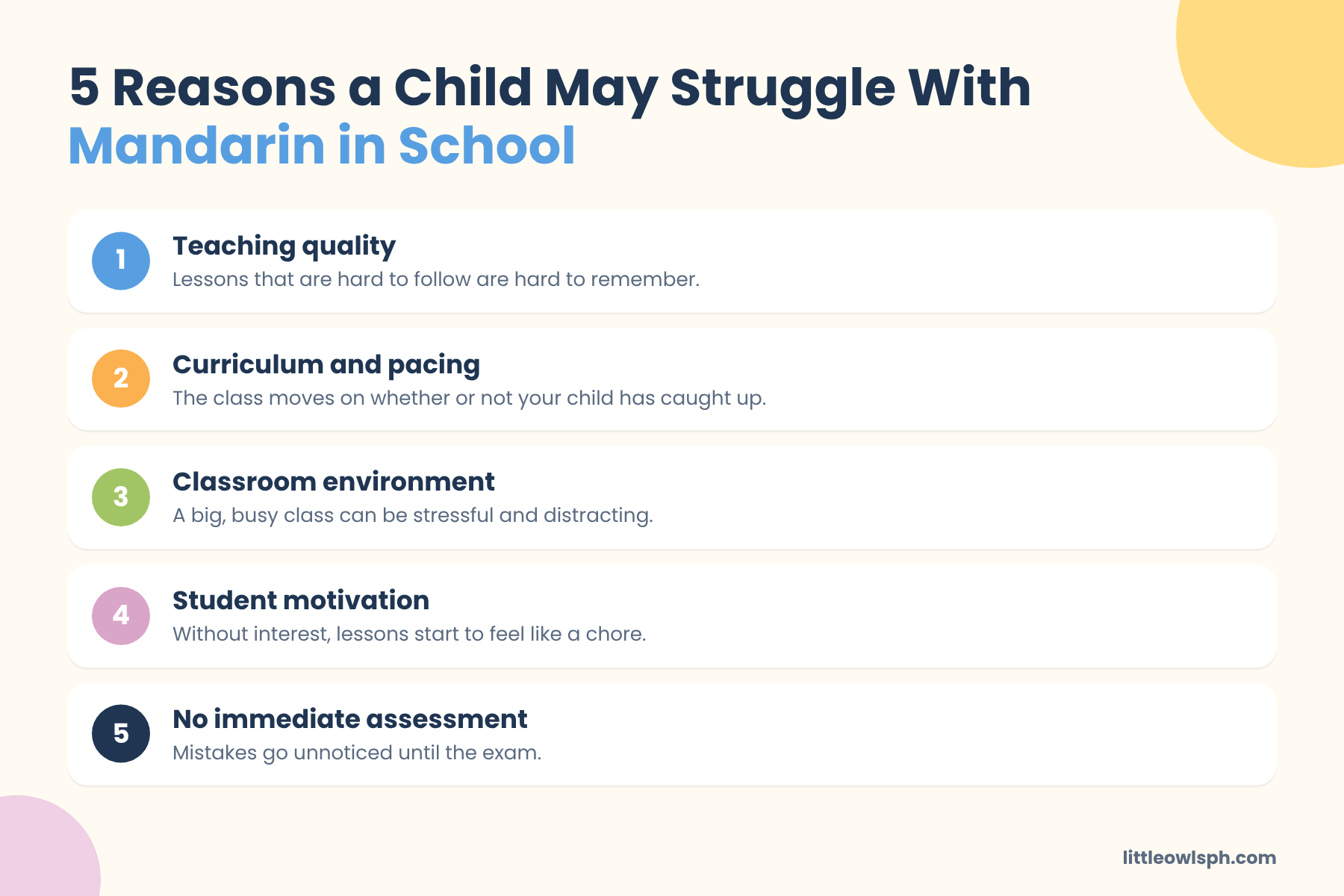
5 Reasons Your Child May Be Struggling With Mandarin in School
Parents often put a child’s difficulty down to ability, and overlook what is happening in the school and classroom. These factors shape a child’s progress, concentration and how much they retain.
- Teaching quality: Poor teaching can leave your child struggling to understand and retain lessons.
- Curriculum and pacing: Rigid, time-based pacing means students fall behind if they do not grasp a lesson on time.
- School and classroom environment: Learning alongside many other students can be stressful and distracting, making it harder to focus.
- Student motivation: An unmotivated student finds it harder to absorb lessons, however well they are taught.
- Lack of immediate assessment: Teachers handle many students at once, so they often cannot give timely individual feedback.
What a Tutor Can Do: The Story of a Student Like Roy
Picture a student like Roy. He is an energetic nine-year-old who would much rather be building Lego or playing football than sitting through a rigid lecture. He is easily distracted by his classmates, and the fast-paced school curriculum made it very hard for him to keep up.
On the verge of failing his Mandarin subject, and visibly stressed before every exam, Roy needed a more focused and personal approach than a traditional classroom could give. His mother decided to invest in a private Mandarin tutor.
- Finding the real problem. Right away, the tutor traced the trouble to messy stroke orders and mixed-up tones.
- Going back to basics. Instead of rushing through the school curriculum, they practiced strokes and tones patiently until Roy felt steady and secure.
- Practicing like the real exam. As the weeks went on, the tutor introduced practice tests that mirrored his school exams.
- Feedback on the spot. Mistakes were corrected in real time, with an explanation of not just what he got wrong, but why.
The result: Roy started looking forward to his lessons. By exam day the anxiety was gone, his writing was neater and his pronunciation clearer. He did not just pass. He achieved his highest score in a Mandarin exam yet.
Roy is an illustration and not an actual student, but the pattern is one we see often: find the weak spots, go back to basics, practice like the real exam, and correct mistakes on the spot.
Online Tutor or Home-Service Tutor?
Once you decide on a tutor, the next choice is between online and home-based tutoring. Consider your child’s learning preferences and your family’s setup. Both have advantages, but for most families one clearly outweighs the other.
Home-Service Tutoring
Face-to-face lessons with the tutor at your home.
Pros
- In-person engagement: students interact directly with the tutor.
- Comfortable environment: familiar surroundings help students relax.
Cons
- Schedule challenges: lessons depend on both the tutor’s and the student’s availability.
- Home distractions: noise, family activity and routine can steal attention.
- Limited location: tutor and student must be in the same place.
Online Tutoring
Live sessions online, with a tutor in real time, from anywhere.
Pros
- Flexible schedule: sessions fit more easily into the family’s routine.
- Learning anywhere: only a stable internet connection is needed.
- Interactive tools: modern tools make learning more engaging.
- On-time learning: no travel means sessions start and end as scheduled.
Cons
- Technical difficulties: needs a stable connection and a working platform.
- Increased screen time: more time on a device during sessions.
Why Parents Choose Little Owls as Their Online Mandarin Tutor
Every child learns differently, and the right support can make all the difference. Little Owls’ tutors turn Mandarin into something your child looks forward to. Our online, interactive lessons are designed for Filipino learners, and each session is shaped around your child’s pace and personality.
- Live classes, taught online. Join from anywhere in the Philippines.
- Small groups of up to 4, or 1-on-1. Choose group classes or 1-on-1 tutoring for individual attention.
- Chinese school exam review. Send us your child’s materials and we will cover them in class.
- Native and near-native Mandarin-speaking teachers based in China.
- Gamified lessons that build confidence in speaking, listening, reading and writing.
Try a Class Before You Decide
A trial class costs ₱599. It is a live online group class of 45 to 60 minutes, and there is no obligation to enroll afterward.
Need help with your child’s Chinese school work? See how our Chinese school tutoring works: 1-on-1 sessions built on your child’s own textbook, homework and exam coverage.
Keep reading: Chinese School Exams: The Complete Parent’s Guide to Preparing (Without the Cramming) and How to Help Your Child with Mandarin Homework (Even If You Don’t Speak Chinese)