When your child begins learning Mandarin, single words like hello and thank you are a good start. But real conversations come from short, everyday expressions. That’s why learning Chinese language common phrases is such an effective next step.
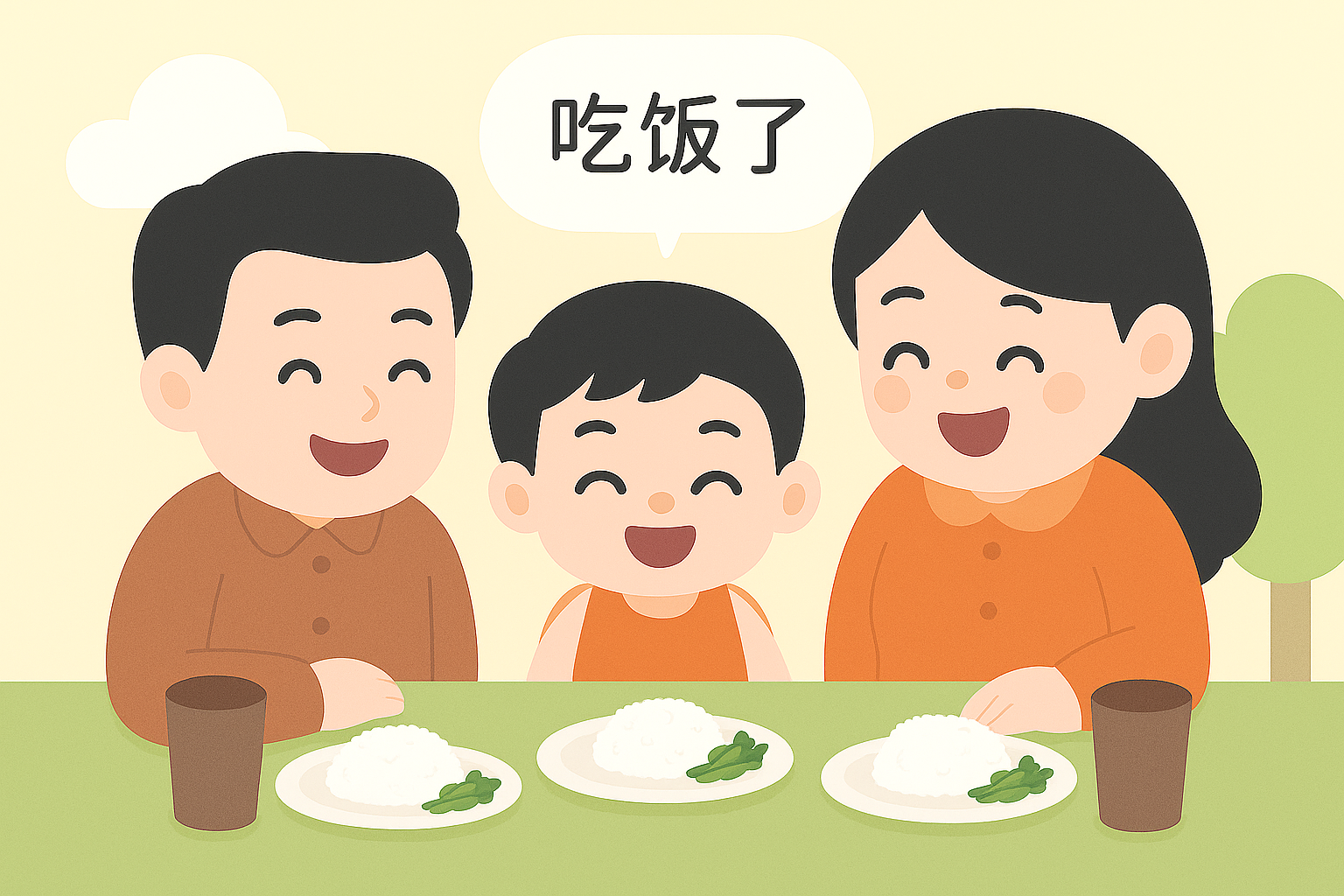
Phrases make learning easier and more natural because they’re how native speakers really talk. In Mandarin, just like in English, phrases don’t always follow textbook rules. Instead of building sentences word by word, kids can instantly pull up a common phrase that sounds natural — almost native. For example, saying 吃饭了 (Chīfàn le – time to eat) works perfectly on its own, even though a literal translation would be longer and more formal.
Ready-made phrases act like shortcuts in conversation. Kids skip the slow step of translating word by word and simply use what they know fits. Repeated often enough, these shortcuts turn into habits — and habits turn into fluency.
👉 In this guide, we’ll first look at why learning phrases is more effective than memorizing words alone, and then move into practical Chinese phrases you can start using with your child — grouped into daily routines, study time, play, emotions, and even travel. Along the way, we’ll share cultural insights, mini-dialogues, and parent tips to help you bring Mandarin into everyday life.
1. Daily Routine Dialogues
The easiest place to start when learning Chinese phrases is with daily routines, which are the repeated moments that shape a child’s day.
Waking up, eating meals, and winding down at night all happen like clockwork, which makes them perfect anchors for learning Mandarin. Because kids already understand the context, slipping in a phrase feels seamless. And over time, these simple expressions become automatic responses.
Examples:
- Parent: 起床了!(Qǐchuáng le!) – Time to get up!
Child: 我来了!(Wǒ lái le!) – I’m coming! - Parent: 吃饭了!(Chīfàn le!) – It’s time to eat!
Child: 好的!(Hǎo de!) – Okay! - Parent: 做得好!(Zuò de hǎo!) – Good job!
Child: 谢谢!(Xièxiè!) – Thank you! - Parent: 洗手!(Xǐ shǒu!) – Wash your hands!
Child: 好,我去洗手 (Hǎo, wǒ qù xǐ shǒu) – Okay, I’ll wash my hands. - Parent: 刷牙!(Shuā yá!) – Brush your teeth!
Child: 我在刷牙 (Wǒ zài shuā yá) – I’m brushing my teeth. - Parent: 睡觉了!(Shuìjiào le!) – Time to sleep!
Child: 晚安!(Wǎn’ān!) – Good night! - Parent: 快点儿!(Kuài diǎnr!) – Hurry up!
Child: 马上!(Mǎshàng!) – Right away! - Parent: 别忘了!(Bié wàng le!) – Don’t forget!
Child: 我记得了!(Wǒ jìde le!) – I remembered!
💡 Cultural note: Routine commands like 洗手 (wash your hands) or 睡觉了 (time to sleep) are staples in Chinese households, often repeated daily. Using them at home gives kids authentic exposure to the same family cues children in Mandarin-speaking homes grow up with.
2. Study and Homework Phrases
Study time is another easy opportunity to bring Mandarin into your child’s routine. Since kids are already focused on learning, they’re more open to using new expressions. So in mixing a few simple phrases during homework or practice sessions, you create a habit where Mandarin becomes part of the learning environment itself.
Examples:
- Parent: 你准备好了吗?(Nǐ zhǔnbèi hǎo le ma?) – Are you ready?
Child: 准备好了!(Zhǔnbèi hǎo le!) – Yes, I’m ready! - Parent: 慢慢说 (Màn man shuō) – Speak slowly.
Child: 好的,我再说一次 (Hǎo de, wǒ zài shuō yīcì) – Okay, I’ll say it again. - Parent: 听我说 (Tīng wǒ shuō) – Listen to me.
Child: 我在听 (Wǒ zài tīng) – I’m listening. - Parent: 写完了吗?(Xiě wán le ma?) – Have you finished writing?
Child: 还没 (Hái méi) – Not yet. - Parent: 再读一遍 (Zài dú yī biàn) – Read it again.
Child: 好的 (Hǎo de) – Okay. - Parent: 别分心 (Bié fēn xīn) – Don’t get distracted.
Child: 我知道了 (Wǒ zhīdào le) – I got it. - Parent: 检查一下 (Jiǎnchá yīxià) – Check it again.
Child: 我检查过了 (Wǒ jiǎnchá guò le) – I’ve checked it.
👉 Parent tip: Even if your child is studying math in English, start the session with “你准备好了吗?” or end with “检查一下.” It builds a habit where Mandarin = learning, making language practice part of their study routine.
3. Play and Fun Phrases
Play is one of the best ways to sneak in language learning without it feeling like a lesson. Being a kid is all about fun, so when they do so in language learning, they repeat words and phrases more naturally, often without even realizing it. That repetition is what makes playtime such a powerful tool for building fluency. Every round of a game or turn with a toy becomes another chance to practice Mandarin in context.
Examples:
- 我赢了!(Wǒ yíng le!) – I won!
- 轮到你了!(Lún dào nǐ le!) – It’s your turn!
- 再来一次!(Zài lái yīcì!) – One more time!
- 我喜欢这个!(Wǒ xǐhuān zhège!) – I like this!
- 太好玩了!(Tài hǎowán le!) – This is so fun!
- 一起玩吧!(Yīqǐ wán ba!) – Let’s play together!
- 小心!(Xiǎoxīn!) – Be careful!
- 换你了!(Huàn nǐ le!) – Now it’s your turn!
- 快一点!(Kuài yīdiǎn!) – Hurry up a little!
💡 Why it works: Kids will shout “我赢了!” (I won!) ten times in one game. That’s ten natural repetitions without it feeling like practice. The same happens with “再来一次!” (One more time!). These playful repetitions stick far better than drilling flashcards.
4. Politeness and Emotional Expressions
Some of the most valuable phrases children can learn are the ones that express care and emotion. These short expressions go beyond objects and actions, giving kids a way to show gratitude, affection, and empathy in Mandarin. They’re powerful because they’re tied to feelings — when a child says “谢谢你帮我 (Thank you for helping me),” they aren’t just speaking another language, they’re practicing kindness.
Mandarin phrases like these are woven into everyday family life. Parents use them constantly — encouraging kids to be careful, reassuring them when they’re worried, or celebrating small victories.
Examples:
- 别担心 (Bié dānxīn) – Don’t worry.
- 我爱你 (Wǒ ài nǐ) – I love you.
- 谢谢你帮我 (Xièxiè nǐ bāng wǒ) – Thank you for helping me.
- 对不起 (Duìbuqǐ) – I’m sorry.
- 没关系 (Méi guānxi) – It’s okay / No problem.
- 请 (Qǐng) – Please.
- 太好了!(Tài hǎo le!) – That’s great!
- 我很开心 (Wǒ hěn kāixīn) – I’m happy.
👉 Parent tip: Use these phrases in real-life family interactions. For example, when your child says “对不起,” reply with “没关系.” This helps kids learn that Mandarin isn’t just for practice — it’s a language of real connection.
5. Travel and Out-and-About Phrases
Learning Mandarin doesn’t have to stay inside the home or classroom. Everyday outings — from visiting a restaurant to shopping or traveling — are great chances to practice short, useful expressions. Kids love using language in real-world settings because it feels like an accomplishment: ordering food, asking a question, or making a request in Mandarin gives them a confidence boost.
These phrases also help children see Mandarin as a living language. It’s not just something they “study,” but something they can use right away in authentic situations. Even a simple “我想要这个 (I want this one)” at a restaurant can make the experience exciting and memorable.
Examples:
- 多少钱?(Duōshǎo qián?) – How much is it?
- 我想要这个 (Wǒ xiǎng yào zhège) – I want this one.
- 厕所在哪里?(Cèsuǒ zài nǎlǐ?) – Where is the bathroom?
- 我可以吗?(Wǒ kěyǐ ma?) – May I?
- 买单 (Mǎidān) – The bill, please.
- 请给我菜单 (Qǐng gěi wǒ càidān) – Please give me the menu.
- 太贵了!(Tài guì le!) – It’s too expensive!
- 好吃!(Hǎochī!) – Delicious!
- 我们走吧 (Wǒmen zǒu ba) – Let’s go.
💡 Cultural note: Mandarin often shows politeness through phrasing rather than by adding “please” everywhere. For instance, asking “我可以吗?” (May I?) already sounds respectful and is more natural than overusing 请 (please).
6. Level Up: From Basic to Next Step
One of the best ways to keep kids motivated in language learning is to show them progress. Phrases aren’t fixed — once a child feels comfortable with a simple version, you can guide them toward a slightly longer or more detailed version. This creates a natural sense of growth, like “leveling up” in a game.
By teaching upgrades step by step, children don’t feel overwhelmed. They start with something easy and instantly usable, then gradually add words to make it richer. This mirrors how native speakers learn: first memorizing short chunks, then expanding them into full sentences.
Examples of leveling up:
- Start: 你好 (Nǐ hǎo) – Hello
Next: 你好,你好吗?(Nǐ hǎo, nǐ hǎo ma?) – Hello, how are you? - Start: 谢谢 (Xièxiè) – Thanks
Next: 谢谢你帮我 (Xièxiè nǐ bāng wǒ) – Thank you for helping me - Start: 我喜欢 (Wǒ xǐhuān) – I like…
Next: 我喜欢吃苹果 (Wǒ xǐhuān chī píngguǒ) – I like eating apples - Start: 再见 (Zàijiàn) – Goodbye
Next: 明天见 (Míngtiān jiàn) – See you tomorrow - Start: 对不起 (Duìbuqǐ) – I’m sorry
Next: 对不起,我迟到了 (Duìbuqǐ, wǒ chídào le) – Sorry, I’m late - Start: 很好 (Hěn hǎo) – Very good
Next: 你做得很好 (Nǐ zuò de hěn hǎo) – You did very well
👉 Parent tip: Treat these upgrades like milestones. Celebrate when your child moves from a one-word phrase to a full sentence. It shows them that Mandarin isn’t static — it grows with them.
7. Mistakes Parents Often Make
Learning a new language at home works best when it feels natural and consistent. But even with the best intentions, parents sometimes make choices that slow their child’s progress without realizing it. These mistakes don’t mean failure — they’re just common pitfalls that can be fixed with small adjustments.
By being aware of these challenges early, you can create a smoother learning experience for your child. The goal isn’t perfection — it’s building confidence and making Mandarin a language your child enjoys using every day.
Common mistakes to watch out for:
- Teaching too many phrases at once
Parents sometimes get excited and introduce a long list of phrases in one go. This overwhelms kids and makes it harder to retain anything.
👉 Fix: Start with 3–5 core phrases tied to daily routines, then expand once those feel automatic. - Ignoring tones
In Mandarin, tone changes meaning. For example, 妈 (mā – mother) and 马 (mǎ – horse) sound similar to English ears but mean very different things. If tones aren’t practiced, kids may be misunderstood.
👉 Fix: Use audio resources or recordings from teachers so kids hear the correct tones repeatedly. - Expecting direct translation from English
Mandarin doesn’t always mirror English word-for-word. Phrases like “慢慢吃 (Màn man chī)” literally mean eat slowly, but they’re used more like enjoy your meal.
👉 Fix: Teach phrases as whole expressions, not as separate words to be pieced together. - Skipping reinforcement
If a phrase is introduced once but never tied to a routine, kids forget it quickly.
👉 Fix: Connect phrases to actions — say “刷牙 (Shuā yá – brush your teeth)” at bedtime every night. - Correcting too harshly
Over-correcting can make kids hesitant to try speaking.
👉 Fix: Model the correct phrase gently, rather than pointing out mistakes directly. Confidence matters more than perfection.
💡 Parent insight: The biggest mistake isn’t mispronouncing a tone or forgetting a word — it’s not using Mandarin at all. Even imperfect practice builds familiarity and comfort, which is what children need most.
8. Fun Practice Ideas for Families
The best language learning doesn’t feel like studying at all — it feels like play. Kids remember phrases better when they’re repeated in games, challenges, and family activities that spark excitement. When Mandarin is part of games and family activities, kids stop worrying about “getting it right” and start enjoying the language as something playful and natural.
These activities also make Mandarin part of family life. When parents join in, it shows kids that language isn’t just homework — it’s something everyone can enjoy together.
Ideas to try at home:
- Phrase of the Day
Write one phrase on a sticky note and put it on the fridge. Everyone in the family has to use it at least three times before bedtime. - Role-Play Scenarios
Pretend you’re at a restaurant, a store, or on a trip. Use Mandarin phrases like “我想要这个 (I want this one)” or “买单 (The bill, please).” - Flashcard Races
Place flashcards with phrases around the room. Call one out in English, and your child has to find and say the Mandarin version. - Game Night in Mandarin
Play board games or card games but only use Mandarin for turns, wins, and actions. “轮到你了 (It’s your turn)” and “我赢了 (I won)” come up naturally. - Story Building
Start a simple story in Mandarin with one phrase like “我喜欢 (I like…)” and let your child continue by adding their own ending. - Emotion Match
Say an emotion phrase like “我很开心 (I’m happy)” and have your child act it out — or vice versa. This ties movement to language.
Family Rewards
Keep track of phrase usage on a chart. If your child uses 10 new phrases in a week, celebrate with a small reward.
💡 Parent insight: The more playful the practice, the more natural it feels. Children won’t remember a phrase because they studied it once, but they’ll never forget shouting “我赢了!” after winning a game of Uno.
FAQs for Parents
Parents often have similar questions when they start introducing Mandarin at home. Knowing what to expect can make the journey smoother and help you avoid second-guessing yourself. Here are some of the most common concerns — along with practical answers that fit real family life.
Q: How many phrases should my child start with?
A: Begin small — three to five phrases tied to daily routines are enough. Once those become second nature, you can add more. What matters is consistency, not quantity. Kids learn faster when phrases are tied to specific actions like waking up, eating, or bedtime.
Q: Should my child learn speaking first or start with characters too?
A: For beginners, focus on speaking and listening. Characters can be introduced later once your child feels confident using phrases aloud. This way, they build fluency and confidence early without feeling overwhelmed by writing.
Q: What if parents don’t speak Mandarin at all?
A: You don’t need to. Even if you only know a handful of phrases, repeating them regularly is enough for your child to practice. Many parents play teacher audio clips or use flashcards to reinforce pronunciation, while simply modeling usage at home.
Q: How fast will my child pick up phrases?
A: Every child learns differently, but with daily exposure most kids start responding in Mandarin within a few weeks. Repetition is the key. When phrases are tied to real routines, they stick much faster.
Q: What if my child mixes Mandarin with English?
A: That’s a normal stage of bilingual learning. Code-switching shows your child is actively using both languages. Over time, with more exposure, they’ll naturally separate the two.
Q: Do I need to correct my child every time they make a mistake?
A: No — too much correction can discourage them. The better approach is to model the right phrase naturally. If they say it slightly wrong, repeat it back correctly so they hear it without feeling criticized.
Q: How can I keep my child motivated?
A: Make it playful. Kids learn best when Mandarin is tied to fun activities, family routines, or rewards. Simple games like “Phrase of the Day” or shouting out “我赢了!” during board games keep motivation high.
Need More Help in Teaching Your Child Mandarin?
Learning phrases at home is one of the best ways to give your child a strong foundation, but sometimes parents want extra support to keep progress steady. That’s where guided practice with trained teachers makes a big difference. In a structured class, kids don’t just repeat phrases — they learn how to use them in conversations with peers, guided by interactive activities and games.
At Little Owls Learning Center, our online Mandarin programs are designed for kids, combining fun with structure so every session feels engaging. Parents often tell us their child starts using new phrases at home after just a few lessons, which is exactly the kind of real-world fluency we aim for.👉
Ready to see the difference? Book a trial class today and discover how quickly your child can start speaking Mandarin with confidence.