It usually starts with a photo in the class group chat: the pointers for next week’s Chinese exam. Three lessons, a passage to memorize, a page of words for dictation. You look at it, then at your child, who says they have already studied. You can’t read a line of it, so you have no way to tell.
If that is your house the week before Chinese school exams, you are far from the only one. And helping doesn’t depend on reading Chinese. What your child needs from you is a start date, fifteen minutes a day, and someone to hold the book while they write from memory.
This guide covers the whole cycle, from reading the exam notice to reviewing the paper when it comes back. Bookmark it and return each quarter.
In this guide
- Why Chinese school exams feel harder
- Exam words decoded: a glossary for parents
- The two-week plan
- How to prepare for each part of the exam
- What changes by grade level
- If no one at home speaks Mandarin
- Exam week and exam day
- After the exam
- Common mistakes
- Checklist
- Questions parents ask
- How Little Owls helps
Why Chinese School Exams Feel Harder Than Other Subjects
In most Filipino-Chinese homes, English and Filipino are the everyday languages. Chinese is something a child hears for one or two periods a day at school and almost nowhere else. That creates a familiar pattern: children can often say more than they can write, and they can recite a passage without knowing what it means.
That becomes a problem at exam time, because the paper asks for the two things these children have practiced least. In dictation they have to write each character from memory, and in comprehension they have to understand a passage they may only know by sound. It is why a child who answers confidently in class can still come home with a low score.
Exam Words Decoded: A Glossary for Parents
Exam notices and textbooks use a small set of Chinese terms again and again. Knowing them tells you what your child is actually being asked to do. Simplified forms are shown first, with traditional forms in brackets where they differ.
| Term | Pinyin | What it means | What your child has to do |
|---|---|---|---|
| 听写 (聽寫) | tīngxiě | Dictation | Hear a word or sentence and write it |
| 默写 (默寫) | mòxiě | Writing from memory | Write out a memorized passage with no prompt |
| 背书 (背書) | bèishū | Recitation | Say a memorized passage aloud |
| 生字 / 生词 (生詞) | shēngzì / shēngcí | New characters / new words | The vocabulary list for each lesson |
| 课文 (課文) | kèwén | Lesson text | The main reading passage of a lesson |
| 造句 | zàojù | Sentence making | Write a sentence using a given word |
| 填空 | tiánkòng | Fill in the blanks | Choose or write the missing word |
| 阅读理解 (閱讀理解) | yuèdú lǐjiě | Reading comprehension | Read a passage and answer questions |
| 作文 | zuòwén | Composition | Write a short essay or paragraph |
| 笔顺 (筆順) | bǐshùn | Stroke order | Write the strokes in the correct sequence |
| 拼音 / 注音 | pīnyīn / zhùyīn | The two sound systems | Write or read the pronunciation |
| 会话 (會話) | huìhuà | Conversation | Oral questions and answers |
Not sure whether your child’s school uses pinyin or zhuyin, or simplified or traditional characters? See our guide to simplified vs traditional Chinese in Philippine schools.
The Two-Week Plan for Chinese School Exams
Three ideas carry the whole plan.
Get the coverage early and sort it. Ask the Chinese teacher for the exam coverage, often called pointers, as soon as it is available. Sort it into dictation, memorized passages, comprehension, and sentence making or composition. Not every school uses all four, and the weighting differs, so ask which parts carry the most marks.
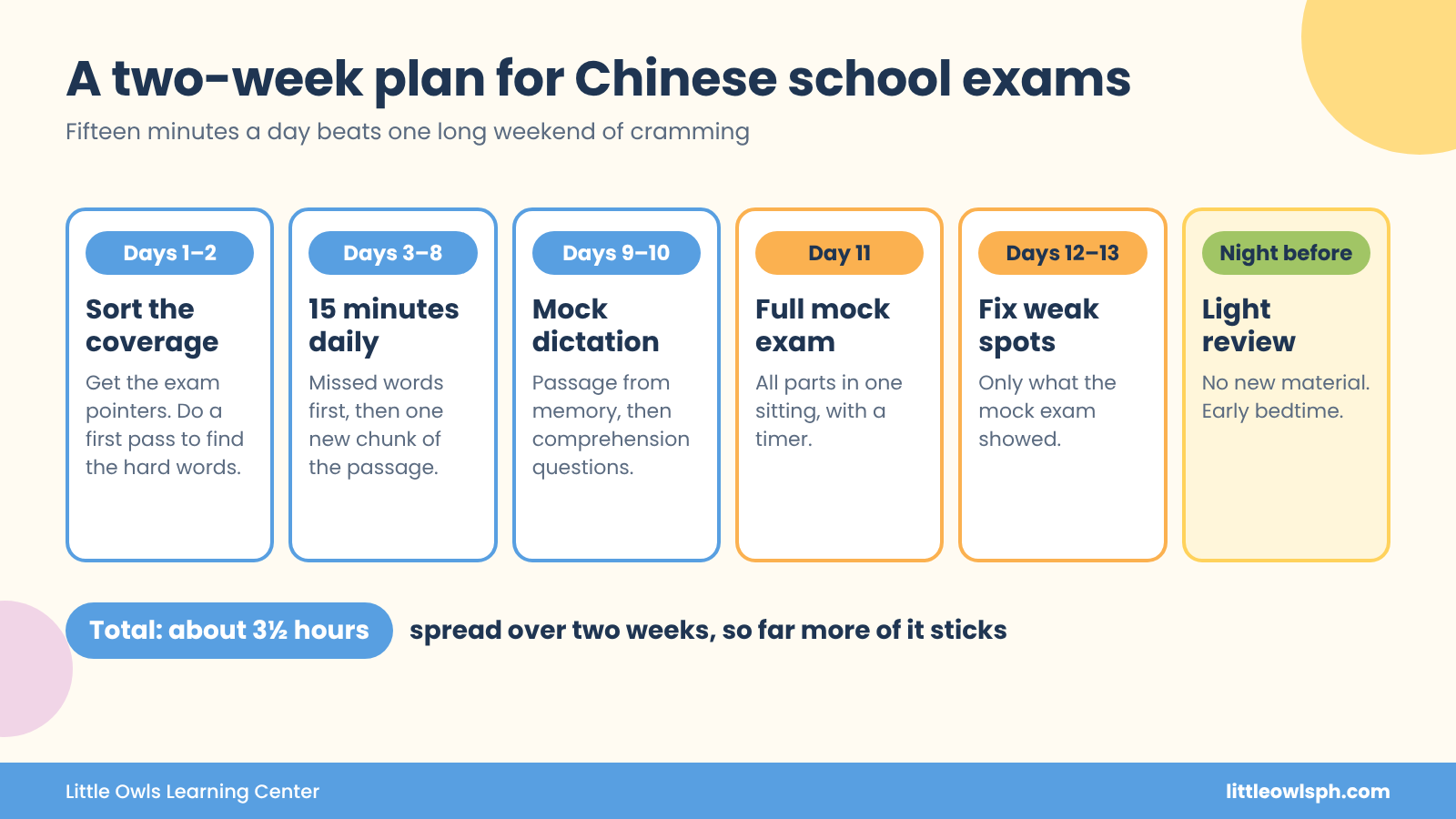
Spread it out. Short daily sessions beat one long weekend of cramming. Researchers call this distributed practice, and a major review of study techniques rated it one of only two methods with strong evidence across ages and subjects. Fifteen focused minutes a day for two weeks is about three and a half hours in total, and far more of it sticks.
Quiz, don’t reread. The other top-rated method in that review is practice testing: closing the book and trying to recall. Rereading and highlighting, which is what most children do when told to “study,” were rated among the least useful.
- Days 1–2: get the coverage, sort it, and do a first pass to find the hard words.
- Days 3–8: 15 minutes daily: missed words first, then one new chunk of the passage.
- Days 9–10: mock dictation and passage from memory. Go over comprehension questions.
- Day 11: full mock exam with a timer.
- Days 12–13: fix only what the mock exam showed.
- Night before: one light review, then an early bedtime. No new material.
Less than two weeks left? Keep the same order and shorten the middle: sort the coverage today, quiz daily, and still do one mock exam two days before.
How to Prepare for Each Part of the Exam
Dictation (听写)
Use cover, write, check. Your child looks at a word, covers it, writes it from memory, then checks it against the book. Words they get right move to a “done” pile. Words they miss come back tomorrow.
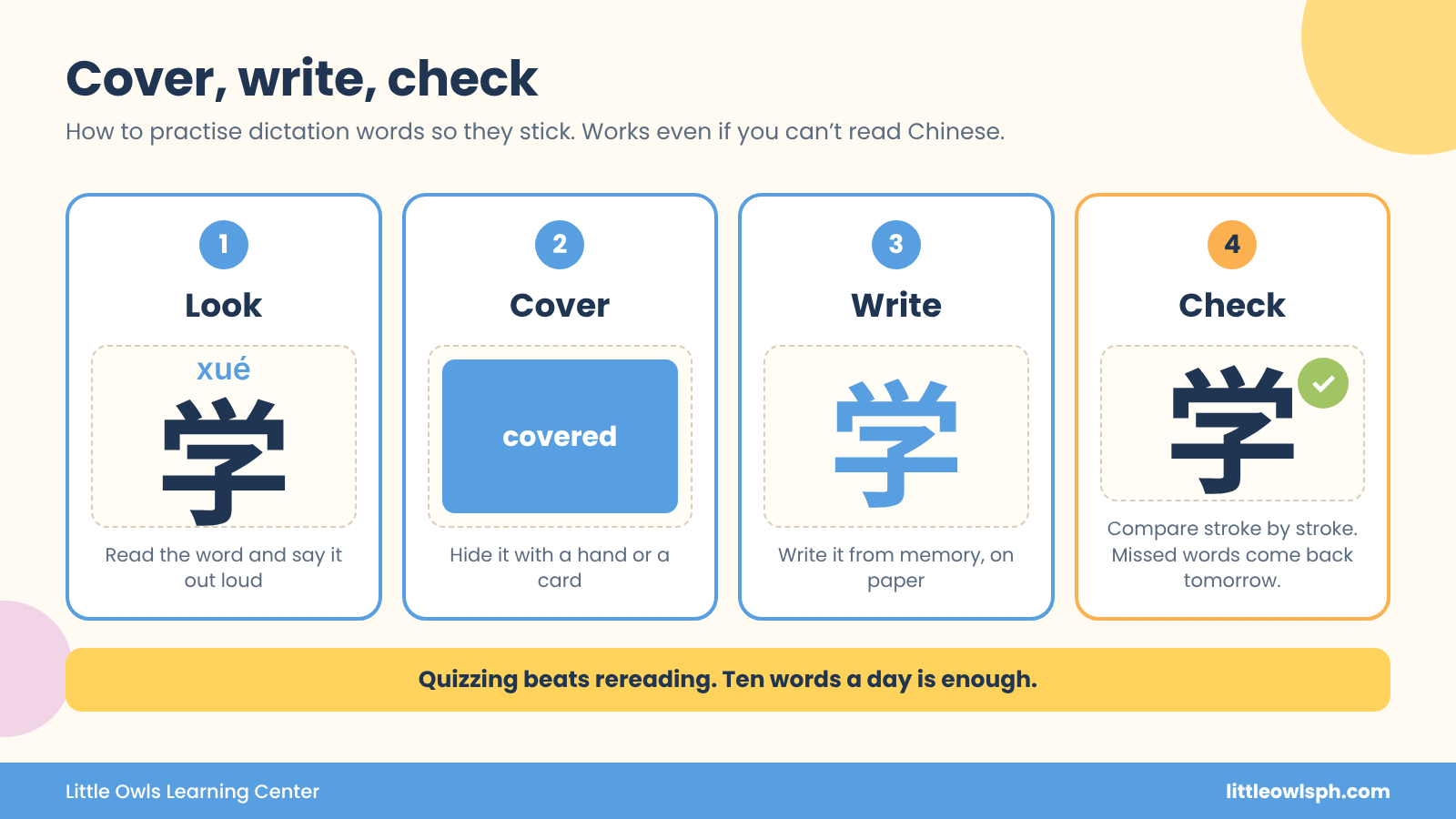
- Practice on paper, because the exam is on paper. Recognizing a character and producing it are different skills.
- Check stroke by stroke. A missing dot or hook usually costs the whole mark.
- Keep an error list of missed words and start every session with it.
- Hold a mock dictation every few days, in mixed order, not textbook order.
Memorized passages (默写 and 背书)
- Meaning first. Have your child explain each line in English or Filipino before memorizing it.
- Learn in chunks of one or two lines, adding a new chunk only when the earlier ones are solid.
- Use first-character prompts: write only the first character of each line and recite from those.
- For 默写, practice writing the passage, not only saying it. Many children can recite a text they cannot write.
Reading comprehension (阅读理解)
- Learn the question words: 谁 (who), 什么 (what), 哪里 (where), 什么时候 (when), 为什么 (why), 怎么 (how). Knowing them tells your child what kind of answer is wanted.
- Read the questions before the passage, then underline where each answer sits.
- Answer in a full sentence that reuses the words of the question. It is safer than inventing new phrasing.
- Practice on the comprehension questions at the end of each textbook lesson, with the book closed for the answers.
Sentence making and composition (造句 and 作文)
- Collect one model sentence for each key word from the textbook, then practice swapping one part: the person, the place, or the time.
- Short and correct beats long and wrong. Marks are lost on wrong characters and word order, not on simple ideas.
- For a short composition, use a fixed frame: who, when, where, what happened, how I felt.
- Have your child write one practice paragraph a week before the exam and ask the teacher or a tutor to mark it.
Oral and conversation (会话)
- Have your child record themselves reading the lesson text, then listen back. Children catch their own tone mistakes faster this way.
- Slow and clear scores better than fast. Practice at half speed first.
- Rehearse the predictable questions: name, age, family, school, favorite food, what they did yesterday.
What Changes by Grade Level
| Stage | What exams usually stress | Session length | The parent’s job |
|---|---|---|---|
| Kinder to Grade 2 | Recognizing characters, simple words, speaking | 5 to 10 minutes | Sit with them and make it a game |
| Grades 3 to 6 | Dictation volume, memorized passages, short comprehension | 15 minutes | Run the quiz and keep the error list |
| High school | Longer comprehension, composition, more vocabulary | 20 to 30 minutes | Check the plan, not every answer |
These are typical patterns, not rules. Your child’s teacher can tell you what their own exam stresses.
If No One at Home Speaks Mandarin
You can still run almost every session. What a parent provides is the routine and the quiz, not the Chinese.
- Read out the English meaning from the vocabulary list and have your child write the Chinese.
- Ask your child to record the dictation list on a phone, then play it back as the quiz.
- Check written answers by matching shapes against the book, stroke by stroke. You don’t need to read a character to see that a stroke is missing.
- Ask the teacher whether the textbook has audio, or whether they can send a recording of the passage.
- Use the glossary above to understand what each part of the notice is asking for.
Exam Week and Exam Day
- The night before: one light review of the error list, pack pencils and an eraser, early bedtime. No new material.
- In the exam, do the items you know first, then return to the hard ones.
- Write something for every item. A blank earns nothing.
- If a character won’t come, write the part you remember and move on. Ask the teacher beforehand whether partial answers or pinyin earn any credit, because schools differ.
- Leave three minutes to check for missing strokes and skipped questions.
After the Exam: Use the Paper
The returned paper is the best study guide for next quarter. Go through it together and sort every lost mark into one of three piles:
- Didn’t know it: the word or pattern was never learned. Add it to the error list.
- Knew it but wrote it wrong: a stroke, a tone, or word order. This needs more writing practice, not more reading.
- Ran out of time or skipped it: this needs a timed mock exam next quarter.
Chinese builds on itself, so words missed this quarter return in later lessons. Ten minutes on the old error list each week keeps the gap from growing.
Common Mistakes When Preparing for Chinese School Exams
- Starting three days before the exam.
- Rereading the lesson and calling it studying.
- Practicing only by saying the words, never by writing them.
- Memorizing passages by sound, with no idea what they mean.
- Skipping the mock exam, so weak spots show up on exam day.
- Putting the paper away without looking at the mistakes.
Checklist
- Coverage received and sorted by exam part
- Hard words found in a first quiz
- Error list started
- 15 minutes a day on the calendar
- Passage understood, then memorized in chunks
- Mock dictation done
- Full mock exam done with a timer
- Weak spots fixed
- Pencils, eraser, early night
- Returned paper reviewed and error list updated
Questions Parents Ask
How early should we start?
Two weeks is enough for most quarterly exams if the sessions are daily. For a child who is behind, start three to four weeks out and spend the first week on older words.
How long should each session be?
About 15 minutes for grade school. Stop while it is still going well. Two short sessions on a weekend day work better than one long one.
My child refuses or cries. What do I do?
Shorten the session and lower the target: five words, done well, then stop. Resistance usually comes from being asked to face too many unknown words at once. Start with the ones they nearly know.
Is memorizing passages a waste of time?
Not if meaning comes first. A passage your child understands gives them sentence patterns they can reuse in comprehension and composition. A passage learned only by sound is forgotten within days.
When does my child need a tutor?
Consider it when the error list keeps growing between exams, when there is a gap from an earlier grade, or when no one at home can check written work. See Does My Child Need a Mandarin Tutor for Chinese School? for a fuller answer.
How Little Owls Helps With Chinese School Exams
Some children need more than a schedule: a gap from an earlier grade, a school that uses a different script from the one they started with, or simply no one at home who can check their work. Our 1-on-1 tutoring can follow your child’s school coverage directly, including exam review. Send us the exam coverage along with the textbook pages or handouts, and the teacher will build the sessions around them. We also match students with a teacher who handles the script and sound system their school uses.
For steady progress between exams, our group classes build the listening and speaking that make exam content easier to absorb in the first place. You can start with a trial class for P599.
Have a question, or want to send us your child’s exam coverage? Message us and we’ll reply with the next step.
Keep reading: How to Help Your Child with Mandarin Homework (Even If You Don’t Speak Chinese) and Need Mandarin Homework Help? Try Personalized Online Mandarin Classes for Kids