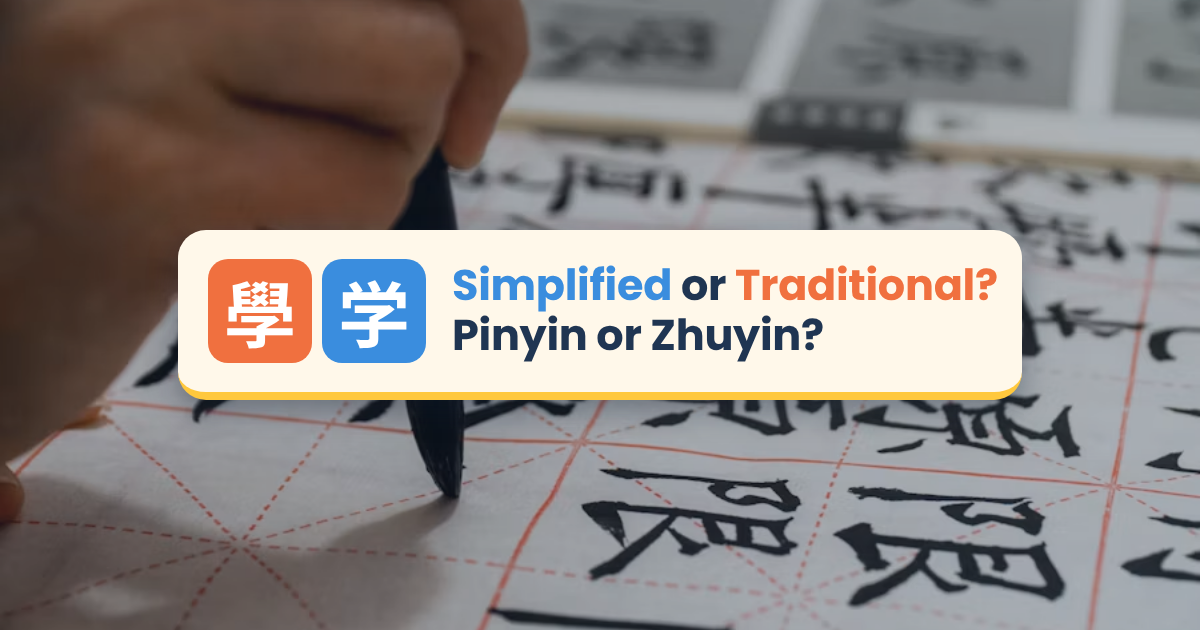
Your child comes home with Chinese homework, and the symbols beside the characters look nothing like the ones in the app you downloaded. Or a cousin from another school writes the same word a different way. Neither child is wrong. They are simply learning Mandarin through two different systems: simplified vs traditional Chinese characters, and pinyin vs zhuyin for the sounds. In the Philippines, both are still in use.
Here is what the difference is, why our schools are split, and what it means when you are choosing a tutor.
Simplified vs Traditional Chinese: Two Choices Every School Makes
Every Chinese program makes two decisions.
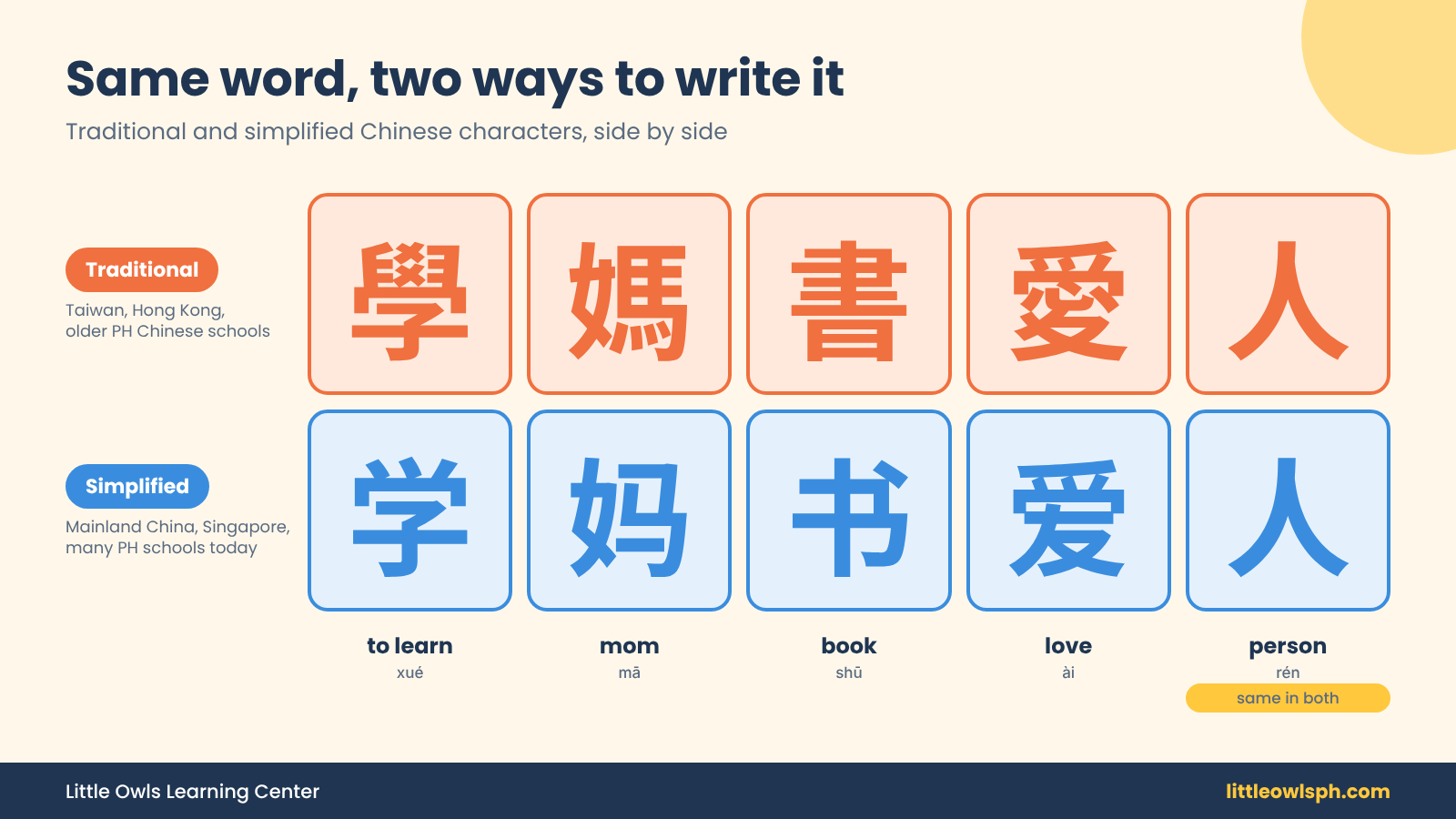
The first is which characters to write. Traditional characters are the older forms, still used in Taiwan and Hong Kong and in most local Chinese newspapers. Simplified characters have fewer strokes and are used in mainland China and Singapore. Many common characters are identical in both. Where they differ, the gap can be large: “to learn” is 學 in traditional and 学 in simplified.
The second is how to teach the sounds. Pinyin spells Mandarin sounds with the Latin alphabet plus tone marks, so “good” is written hǎo. Zhuyin, also called bopomofo, uses 37 symbols of its own, so the same sound is written ㄏㄠˇ.
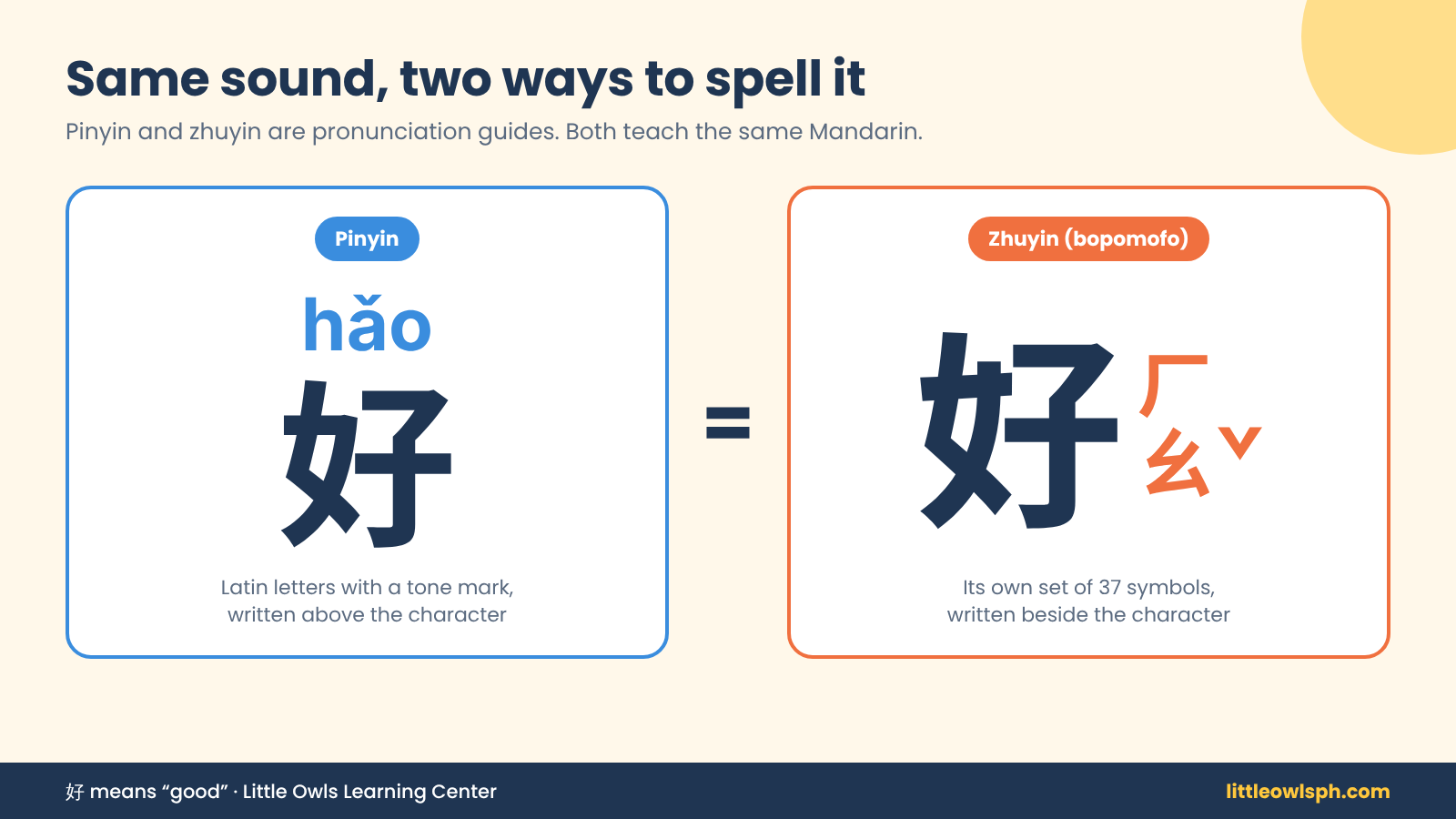
One point matters more than any other: pinyin and zhuyin are only pronunciation guides. A child who learns with zhuyin and a child who learns with pinyin are learning to say the same Mandarin.
Why Philippine Schools Are Split
The split is historical. For decades after the war, the Chinese departments of local schools were supervised from Taiwan, which also supplied the textbooks. That is where traditional characters and zhuyin came from.
Things changed in the 1970s. Chinese schools became Philippine private schools, Chinese class time was cut to a maximum of two hours a day, and the Philippines opened diplomatic relations with mainland China in 1975. Schools began choosing their own materials, and several different textbook sets came into use.
In 1991, the Philippine Chinese Education Research Center was founded. It encouraged schools to teach Mandarin as a second language and to use pinyin. From the late 1990s onward, many schools moved to simplified characters and pinyin. Some older schools kept traditional characters and zhuyin, and some teach a mix.
The result is that two schools a few blocks apart can teach Chinese in visibly different ways, one in simplified characters and the other in traditional. For the fuller history, see Ellen Palanca’s study of Chinese education in the Philippines.
How to Find Out What Your Child’s School Uses
Ask the Chinese department three questions:
- Do you teach simplified characters, traditional characters, or both?
- Do you use pinyin, zhuyin, or both?
- Does any of this change in the upper grades?
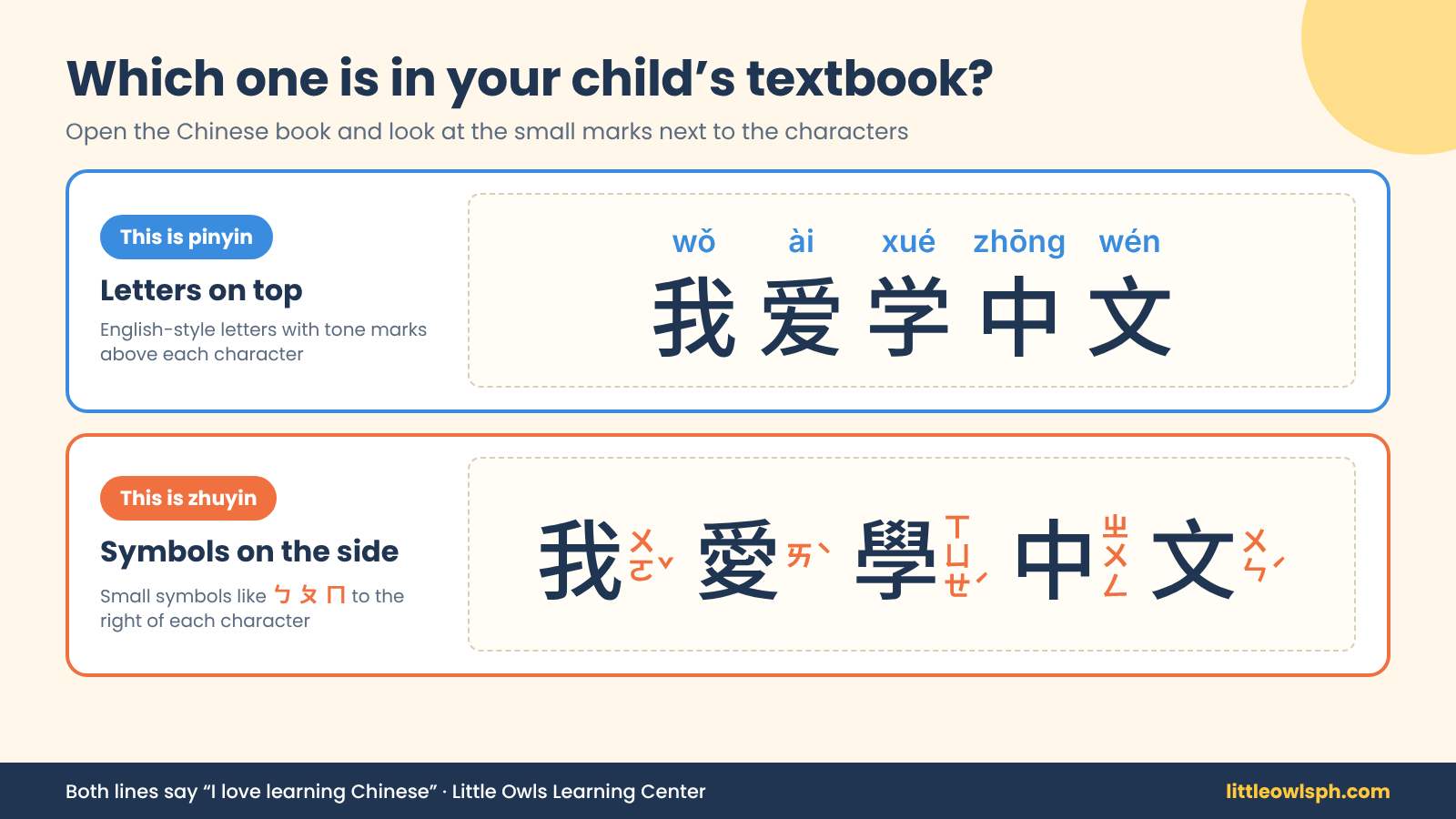
You can also check the textbook. Latin letters with tone marks above the characters mean pinyin. Small symbols such as ㄅ ㄆ ㄇ beside the characters mean zhuyin.
Which One Should My Child Learn?
On simplified vs traditional Chinese, the school’s system comes first if your child is in a Chinese school, because that is what the exams are written in.
Beyond school, simplified characters and pinyin are the more widely used pair. Pinyin is how most people type Chinese on a phone or computer, how most dictionaries and learning apps are organized, and what the HSK and YCT proficiency exams are built around.
Learning one does not lock your child out of the other. Children who know zhuyin usually pick up pinyin quickly, because they already know the Latin alphabet from English and Filipino. And a child with a solid base of simplified characters can learn to recognize traditional forms later, since so many characters are shared.
How Tutoring Fits
At Little Owls, our regular group classes teach simplified characters with pinyin. Here is how that works for different families.
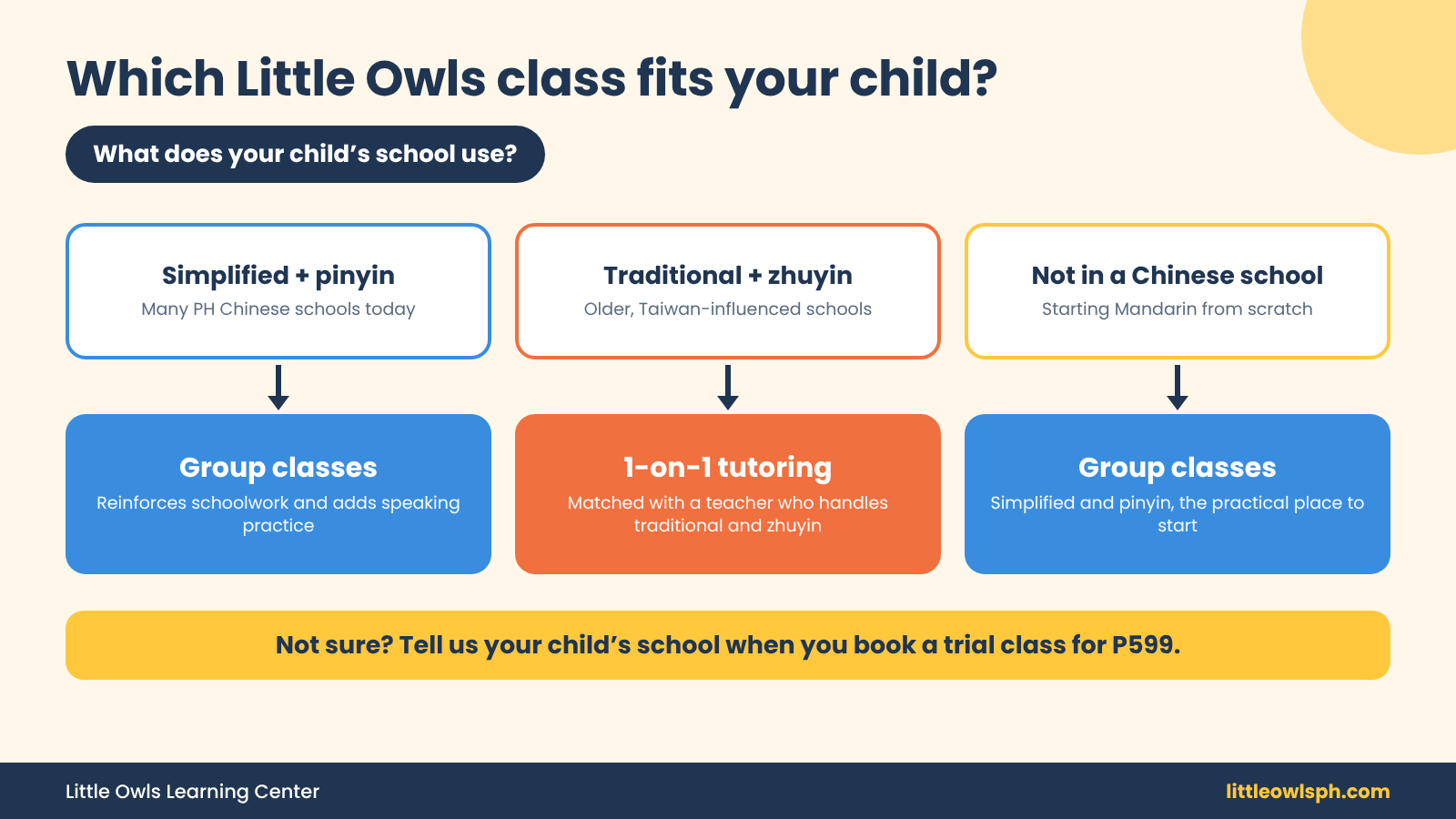
If your child’s school uses simplified and pinyin, our classes reinforce schoolwork directly while adding the speaking practice that a full classroom rarely has time for.
If your child’s school uses traditional and zhuyin, group classes still build listening, speaking, and confidence, because the spoken language is the same. For help with school homework and exam review in the school’s own system, our 1-on-1 tutoring can be matched with a teacher who handles traditional characters and zhuyin. Tell us what your child’s school uses when you enquire, and we’ll pair you with the right teacher.
If your child is not in a Chinese school, simplified and pinyin are the practical place to start, and our regular classes are designed for exactly that.
Not sure which fits? Tell us what your child’s school uses when you book a trial class for P599, and we will recommend the right track.