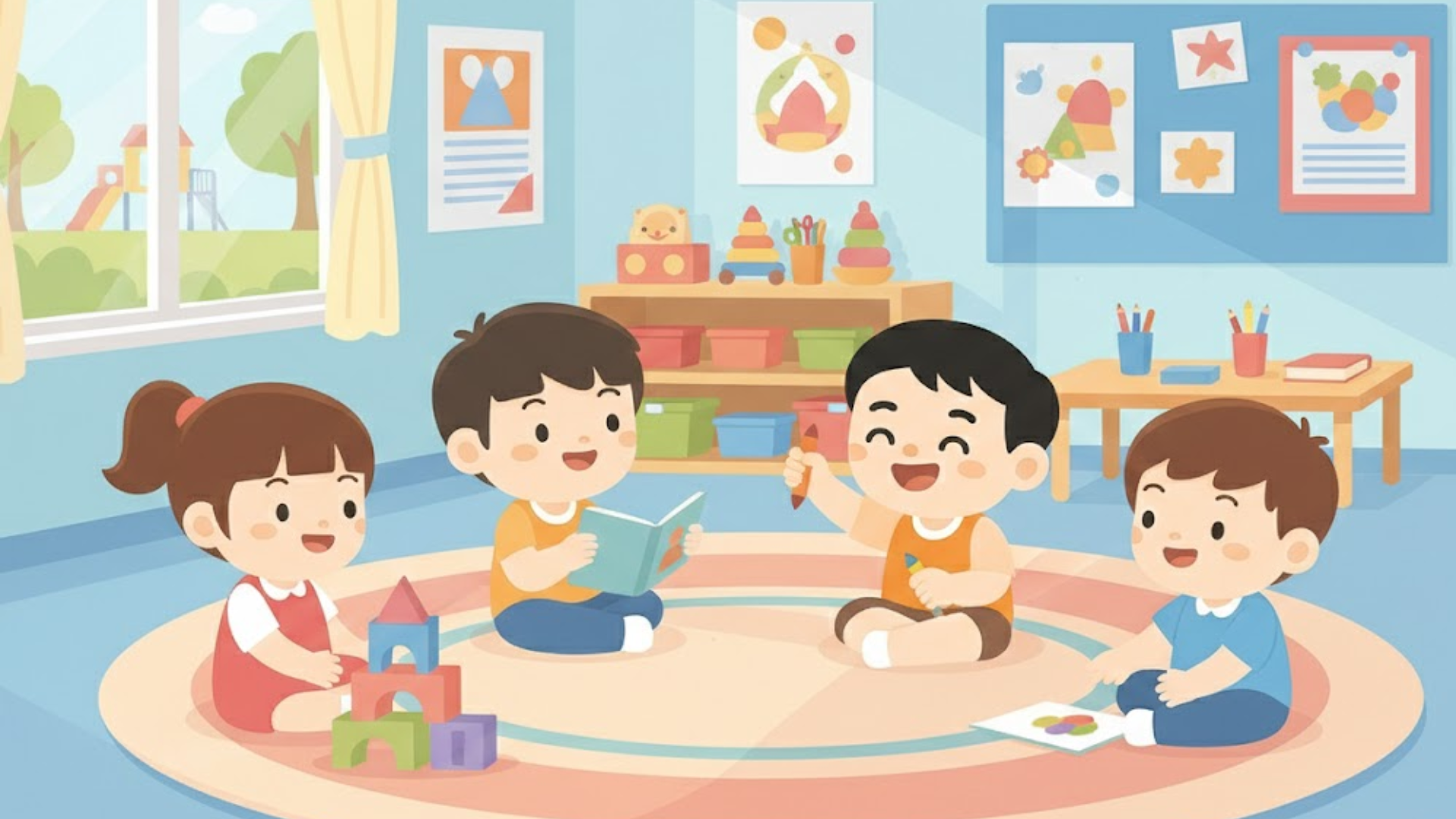
We want our kids to have it all. We want them on the field for sports to ensure they have an athletic outlet and to finally pry the iPad out of their hands so they can stay active. We want them in music lessons, imagining a future where they’re playing a violin concerto at a gala (or at least a classic at a family dinner). And we definitely want them learning a second language like Mandarin, because we know it’s the global passport they’ll need for a 2040 career.
We want the best, but life has a way of parking itself right in our path.
However, the reality check for any parent navigating the urban sprawl is that achieving these goals often feels like a daily logistical nightmare. Whether you are navigating the BGC-Makati corridor or braving the rush hour across Metro Manila, there is that 5:00 PM to 8:00 PM window where time simply seems to vanish.
If you’ve ever found yourself white-knuckled on the steering wheel, staring at a sea of red brake lights while your child sits in the backseat, you’ve likely asked yourself: “Is there a shortcut to all of this?“
You watch the minutes tick away, worrying about the unfinished homework waiting at home. Or worse, you look in the rearview mirror only to see your child mindlessly scrolling on a screen for the entire hour-long commute.
But what if you could hack the traffic? What if that 45-minute crawl from school to your front door could be reclaimed? Today, we’re exploring how to turn the downtime of city traffic into a high-productivity zone for your kids, without adding to their stress or yours.
The Prep Work: Setting the Stage for Productive Downtime
Before jumping into the hacks, start with a quick audit of the afternoon. First, check the vitals, such as an urgent homework deadline. Or try to gauge whether your child is genuinely exhausted and in need of a 15-minute power nap. If there isn’t a pressing academic fire to put out, you can pivot toward these high-impact, long-term activities listed below.
Of course, you have to remember that the goal isn’t just to “stay busy,” but it’s to ensure that we aren’t defaulting to more screen time. If a device is coming out, we want to ensure it’s serving a purpose beyond endless brain-rot TikTok and YouTube videos.
Without further ado, here are three ways to reclaim those hours:
1. The “Passive Ear” Strategy (Audio-Immersion)

We all have our favorite podcasts or vlogs that we use to pass the time during a long commute. So the idea here is why not apply that same background learning to our kids? Instead of the white noise of traffic or the chaos of a viral video, your child can be absorbing complex concepts without even trying.
- The Hack: Use your car’s Bluetooth to play educational audio tailored to their current school week.
- The Science Sample: If they are studying the Solar System, play an engaging space-themed podcast or a catchy song about the planets.
- The History Sample: If they have a quiz on Philippine history, listen to a storytelling-style account of local heroes.
- The Benefit: This replaces “iPad Brain,” i.e., the passive consumption of visual noise, with Active Listening. By the time you reach your condo’s basement, your child has banked another 30 to 45 minutes of stealth studying. Whether it’s the tones of a new language or the facts of a science chapter, the more they hear it in a relaxed environment, the more natural the information feels when they finally sit down for an exam.
The “Steve Jobs” Rule (Active vs. Passive Screen Time)
There is a famous irony in the tech world. Steve Jobs, the man who gave us the iPad, famously restricted his own children’s use of gadgets at home. When asked if his kids loved the iPad, he simply said, “We limit how much technology our kids use.” Jobs’ legacy wasn’t just a billion-dollar fortune; it was his belief in the dinner-table conversation over the digital screen. He understood that while tech is a masterpiece of engineering, it should never replace a child’s active engagement with the world.
But as parents in 2026, we know that a flat no iPad rule is often a recipe for a backseat meltdown.
The secret isn’t necessarily to ban the device, but to reclaim the intent. Don’t just take the screen away—give them something better to do with it.
2. The “Active Choice” Pivot (Tactile & Curated Tech)

The goal here is to move your child from passive consumption (watching someone else play) to decision-making mode.
- The Hack: Curate the device so it becomes a tool for their existing passions.
- The Strategist: If your child loves chess, replace YouTube with a chess mobile app where they have to calculate the next move.
- The Artist: If they are a budding pianist, swap the streamers for virtual piano apps or composition tools they can practice on the way home.
- The Linguist: For Mandarin, this is where we transition to interactive tools. At Little Owls, we developed the “Choose Your Adventure” series specifically for this. Instead of a video, they are in a story where they must decide the plot in Mandarin. Or, use our HSK digital flashcards to turn the commute into a memory game.
- The Benefit: This shifts the brain from a “Theta” state (passive/dreamlike) to a “Beta” state (active/problem-solving). When they arrive home, they aren’t spaced out from an hour of brain-rot content; they are mentally warmed up and ready for the evening.
Leveraging Connectivity to Beat the Traffic
Perhaps the most powerful way to reclaim your afternoon is to leverage the connectivity we often take for granted. Just 15 years ago, if you wanted your child to learn from a specialist, you had to fight through traffic to get to a physical center, adding more travel time to an already exhausted day. Today, the classroom is wherever you are.
Post-pandemic, online learning has evolved from a backup plan to a highly efficient tool. By bringing the teacher to the backseat, you turn the car into a mobile academy.
This brings us to our last tip.
3. The Micro-Session Hack
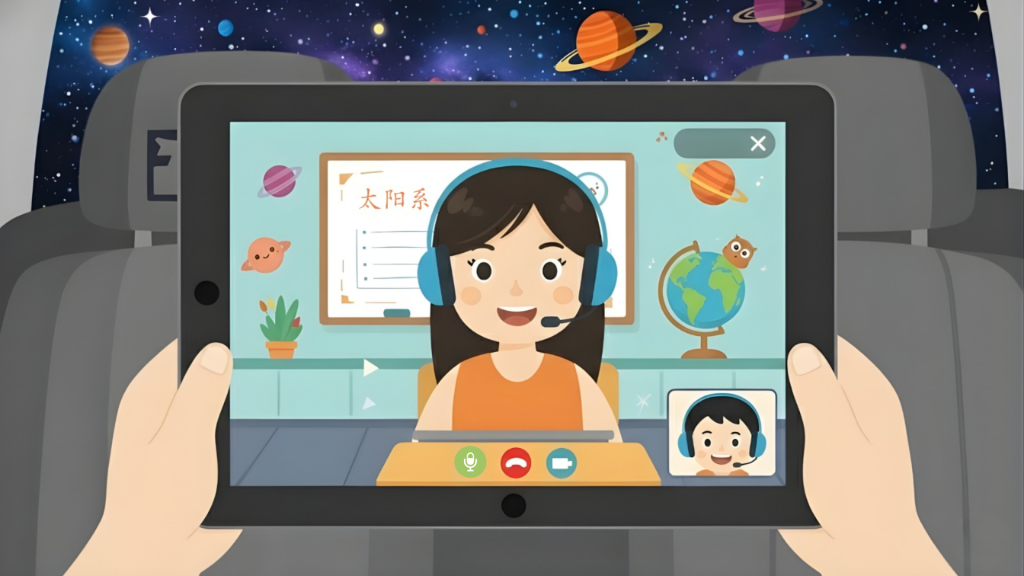
The secret to online learning during a commute isn’t a long, grueling lecture; it’s the 30-minute high-impact session.
- The Hack: Schedule a 30-minute targeted session during the peak scramble hours (5:00 PM to 6:30 PM).
- For Academic Support: Have a tutor jump online to help with a specific math assignment or review a science concept while you’re moving between locations.
- For Mandarin Mastery: At Little Owls, we also offer 1-on-1 focused sessions. In just 30 minutes, our teachers can guide your child through homework, practice conversational tones, or advance through their school’s curriculum—all while you’re navigating the BGC-Makati border.
- The Benefit: Your child reclaims home as their sanctuary, which is the ultimate win for the family. By finishing the heavy lifting of tutoring and homework in the car, home becomes a place of rest again. Instead of your child still hovering over a desk at 8:00 PM, they can walk through the front door, have dinner, and actually relax. You aren’t just making the commute productive; you’re protecting your child’s sleep and your family’s peace.
Reclaim Your Evening, One Commute at a Time
The after-school scramble doesn’t have to be a lost cause. You don’t have to choose between your child’s productivity and your family’s peace of mind. By reclaiming those hours on McKinley Road or the C5, you aren’t just teaching them a new language or finishing a math assignment, but you are essentially buying back your time together at home.
Imagine walking through your front door at 7:00 PM knowing the heavy lifting is already done. No homework wars, no late-night cramming, and no guilt over an afternoon wasted on a screen.
At Little Owls, we specialize in making this transition seamless. Whether it’s through our interactive storybooks or our online sessions, we help turn your car into a mobile academy that fits into your busy BGC or Makati lifestyle.
Ready to turn your next commute into a breakthrough?
We invite you to experience the “Little Owls” difference firsthand. Let’s see how much your child can achieve in just 30 minutes.