Most people would casually say, “Start them young.”
Whether it’s a sport, a musical instrument, or any ambitious undertaking, we intuitively want our children to begin while they are at that magical age where they soak up information like a sponge.
But in the world of language learning, particularly with a language as nuanced as Mandarin, the window between three and five years old offers something far more profound than just information absorption. Researchers call this period “The Great Shift,” and it has less to do with flashcards and everything to do with social intelligence.
At this age, a critical transformation happens in a child’s mind. They begin to move past the natural “egocentrism” of toddlerhood and enter a phase where they can use language as a perspective-switching tool.
When you introduce Mandarin during this window, you not only help your child acquire a new language but also nurture emotional intelligence, deepen empathy, and strengthen cognitive flexibility. And these are going to be crucial, especially when your child enters adulthood.
Theory of Mind

To understand how we can best support a preschooler’s growth, we must first look at a neurological milestone called Theory of Mind (ToM).
Theory of Mind is essentially the capacity to understand others by ascribing mental states to them. Put simply, it is the ability to realize that other people’s thoughts, beliefs, intentions, and emotions are distinct from our own. It is the cognitive bridge between “me” and “you.”
Before the age of three, children are naturally egocentric. This shouldn’t be confused with selfishness, but rather kids at this age are neurologically unable to conceive that your perspective differs from theirs. A classic hallmark of this stage is the toddler playing hide-and-seek: they believe they are perfectly hidden simply because their own eyes are closed. If they can’t see you, they assume you cannot see them.
However, around age four, a cognitive lightbulb switches on. They begin to pass what researchers call the “False Belief Test,” finally realizing that people can hold thoughts or beliefs that don’t necessarily match reality. This shift is where the “Social Compass” is born. When a child develops a strong grasp of ToM early on, their experience of the world shifts from a passive “What is happening to me?” to an active “How are we interacting?”
By accurately mapping the internal states of others, they gain a massive head start and start building the biological foundation they will need to lead, negotiate, and thrive for the rest of their lives.
Why Language is the Key to Reading People
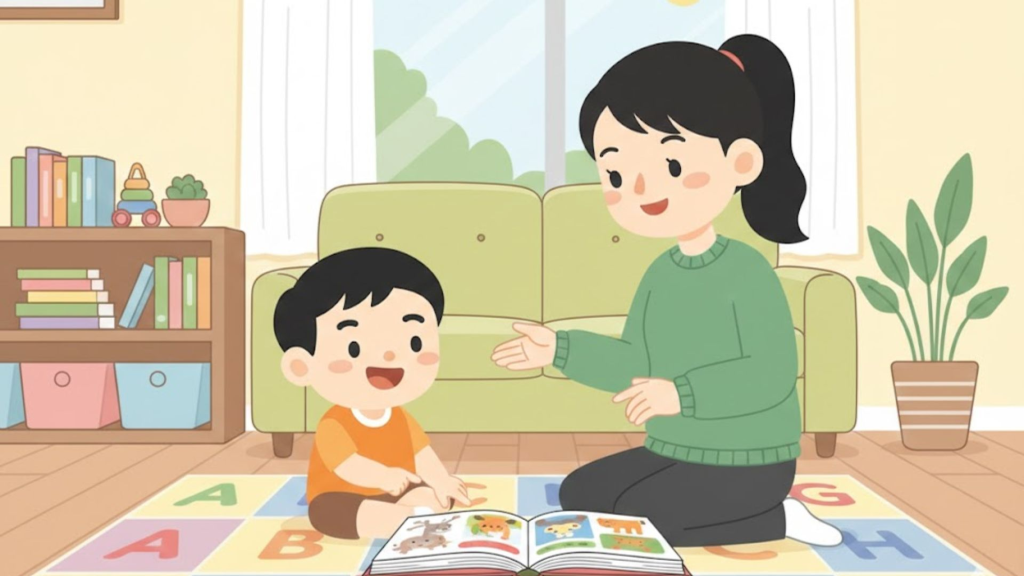
While your child is navigating these critical preschool years, their burgeoning Theory of Mind is intrinsically linked to their language development. In fact, a comprehensive meta-analysis of childhood development reveals a powerful correlation between linguistic skill and ToM. It suggests that learning a language and learning how to read people are truly two sides of the same coin.
Science proves that children with strong language skills are almost always ahead in their understanding of others. While kids master many milestones between ages two and five, such as walking to counting, nothing is as closely tethered to their social intelligence as their ability to communicate.
This connection is physical. The area of the brain responsible for learning new vocabulary sits directly adjacent to the region that recognizes faces and voices. This area, known as the Temporoparietal Junction (TPJ), serves as the brain’s “social hub,” where we process new words, recognize identity, and interpret the hidden beliefs of others. Because these neural pathways are neighbors, they talk to each other constantly; when you stimulate one, you strengthen the other.
While acquiring any second language is beneficial, priming this developmental window with Mandarin offers a unique cognitive edge. Below, we’ll explore why this specific language acts as a high-intensity workout for your child’s social hub.
The Mandarin Advantage
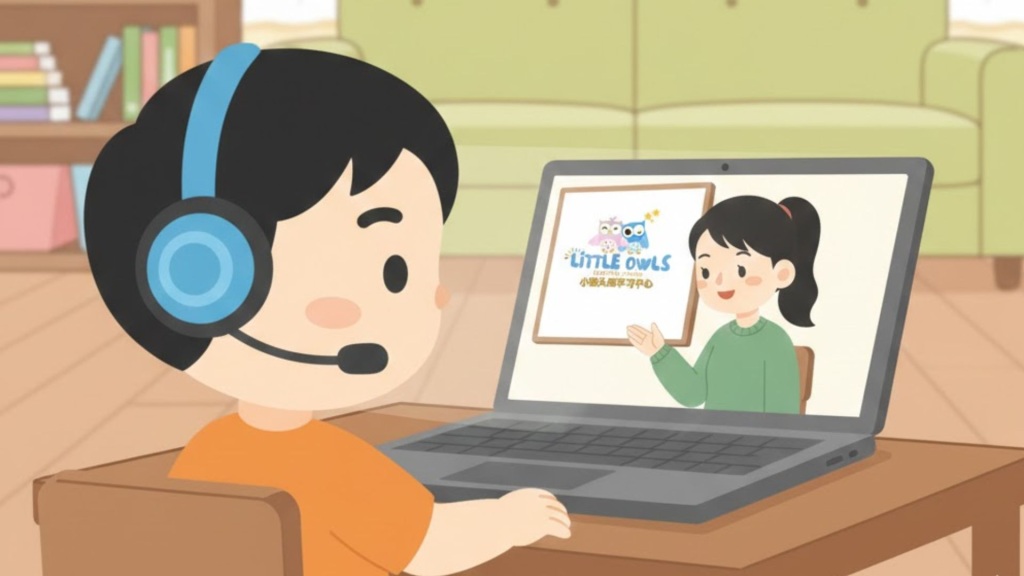
While any second language is beneficial, Mandarin offers a unique neurological workout that other languages simply cannot match. Research indicates that Mandarin-speaking children may actually understand what people want, their internal desires and intentions, earlier than children who speak only English. Because the language and its cultural framework are deeply rooted in intent rather than abstract thinking, it provides children with a richer mental-state vocabulary that prioritizes understanding the goals of others.
Furthermore, the benefits extend into the realm of Executive Functioning. It is well-documented that Mandarin-speaking environments place a high value on impulse control, and children in these settings often outperform their peers in focus and mental discipline from an early age.
So when you introduce Mandarin during the Great Shift (ages 3 to 5), you are essentially providing the specific linguistic factors that help a child’s Social Compass flourish on an accelerated timetable. This advantage is built through three distinct channels:
1. Tonal Sensitivity: Training the Ear for Empathy
In English or Spanish, if you raise your pitch, the meaning of the word remains the same. You simply sound surprised or inquisitive. In Mandarin, however, the pitch is the meaning (妈 for mother vs. 马 for horse).
- The Difference: This forces a child to become hyper-aware of paralinguistic cues, which don’t just refer to what is being said, but exactly how it is being said.
The Long-Term Win: Researchers have found that this tonal training makes children better at reading the room as adults. And in mastering tones early, they become more sensitive to the emotional prosody in people’s voices, which is a core component of high-level empathy and Theory of Mind.
2. Character Logic: Expanding Cognitive Flexibility
Most languages use an alphabet to represent sounds. Mandarin uses logograms (characters) that represent concepts and radicals.
- The Difference: Learning characters requires a sophisticated form of pattern recognition that bridges the gap between the visual and semantic parts of the brain.
The Long-Term Win: This builds incredible cognitive flexibility. When a child maps a visual character to a concept and a specific tone simultaneously, they are engaging more brain real estate than they would in a purely phonetic language.
3. Language as a “Perspective-Switching” Tool
When a child learns Mandarin alongside English or Filipino, they learn that the same object (e.g., an apple) can be represented by entirely different sounds (apple vs. píngguǒ) depending on their audience.
The Link: This constant switching reinforces the realization that they must adjust their communication based on what the other person knows. This exercise in social logic is why bilingual children are statistically faster at passing Theory of Mind tests than their monolingual peers.
The Little Owls Difference: Moving Beyond Rote Memorization
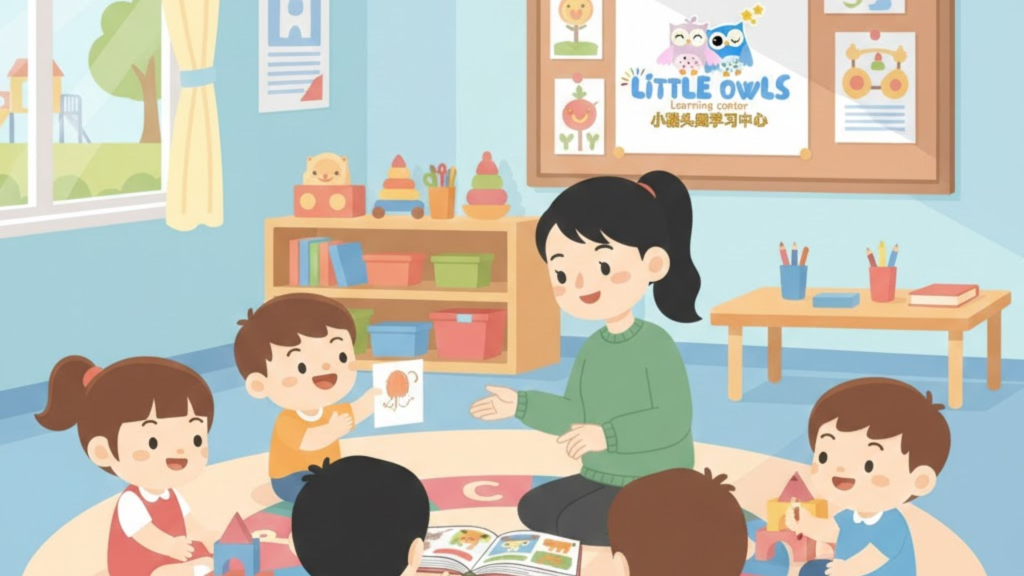
Yet, while the potential developmental benefits of Mandarin are clear, finding the right program remains the primary challenge for parents.
Mandarin is a language of immense complexity. As mentioned, it is character-based rather than alphabetic, meaning a student must eventually internalize thousands of unique logograms to achieve literacy. When you layer on the four distinct tones (where a slight shift in pitch completely alters a word’s meaning), it becomes clear that effective communication requires more than just a teacher.
Unfortunately, traditional schools often attempt to solve this complexity with outdated methods: rote memorization and repetitive drills. What you need is a specialist who understands how to guide your child through these linguistic nuances during their most critical years of growth.
And the best way to bridge that gap is to approach the child through a medium that is native to them, i.e., the science of fun.
That’s why at Little Owls, we take a different approach. We understand that for a four-year-old to achieve meaningful learning, the process must be engaging. This is our motivation for designing a gamified curriculum that is more aligned with how a child’s brain actually grows during the “Great Shift.”
We’ve transformed the complexities of character logic and tonal sensitivity into an interactive adventure, ensuring our students move beyond simple memorization to truly live the language. We pride ourselves on an environment that is intentionally fun but not just for the smiles, but because we know that joy is the essential catalyst for long-term cognitive growth.
Ready to give your child a two-year head start? Experience the Little Owls difference and watch their social and cognitive potential flourish.
Frequently Asked Questions
Actually, the opposite is true. The brain’s social hub (the TPJ) is highly adaptive during the preschool years. Introducing a language as structurally different as Mandarin doesn’t crowd the brain; it expands its flexibility. Think of it as adding a new set of tools to their cognitive toolkit, they learn to switch between mental codes even more efficiently.
Not at all. Theory of Mind is a developmental milestone, not an IQ score. While some children may have higher focus than others, the social benefits of Mandarin, like empathy and reading the room, are accessible to every child because they are built into the way the language is heard and spoken.
That is perfectly fine! In fact, most of our students come from non-Mandarin-speaking households. The benefit comes from the child’s own mental effort in decoding the tones and characters. Because our program is gamified and immersive, they internalize the logic of the language through play, which is often more effective than formal study at home.
Keep reading: 9 Reasons Why Mandarin is the Language of the Future and The 5 Best Second Languages for Kids to Learn in 2026